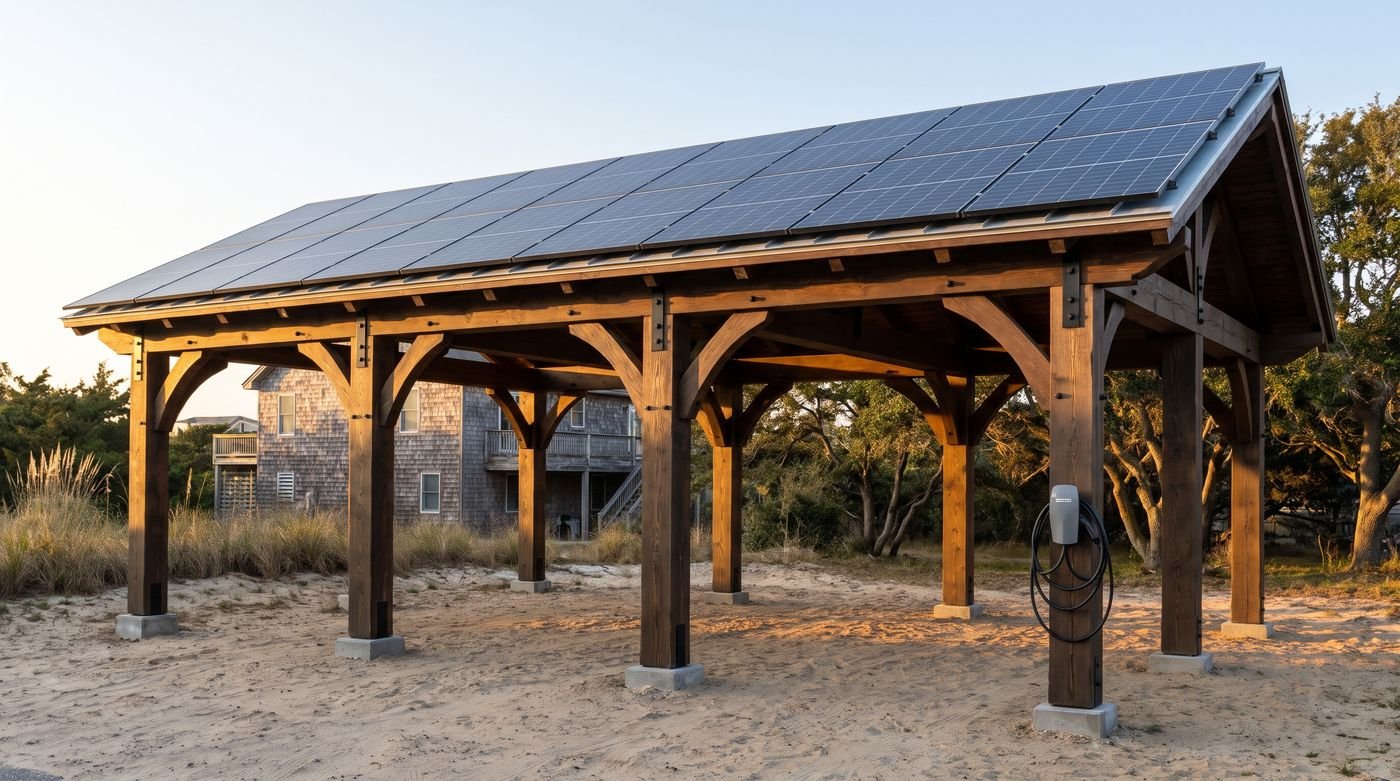
How it works
Three parts, one loop: a solar roof, a vehicle that can send power back out, and a two-way charger between the vehicle and the house.
1. The solar roof
A Bugging Out carport is sized for two full-size trucks side by side, roughly 24 feet by 24 feet, framed in heavy timber posts and beams. That much roof holds about 8 kW of modern solar panels. In coastal North Carolina, a system that size makes around 30 kWh on an average day over the year — more on long summer days, less in winter and under clouds.
Electric pickups and SUVs typically go about 2 to 2.5 miles on each kWh, so a day of sun adds roughly 60 to 75 miles of driving.
2. The vehicle is the battery
Home battery systems usually hold 10 to 15 kWh. A full-size electric truck or SUV holds about 100 kWh or more. That's why the vehicle, not a box on the garage wall, is the heart of the system.
What that battery buys you in an outage:
| How you use power | Per day | A 100 kWh battery lasts |
|---|---|---|
| Normal living (U.S. average) | about 29 kWh | about 3 days |
| Essentials: fridge, freezer, lights, fans, well pump, internet, phones | about 10–15 kWh | about 7–10 days |
| Essentials plus a sunny day on the carport | sun adds back about 30 kWh | it can keep going |
Estimates. Air conditioning, electric heat, water heaters and well pumps vary a lot from house to house.
3. The two-way charger
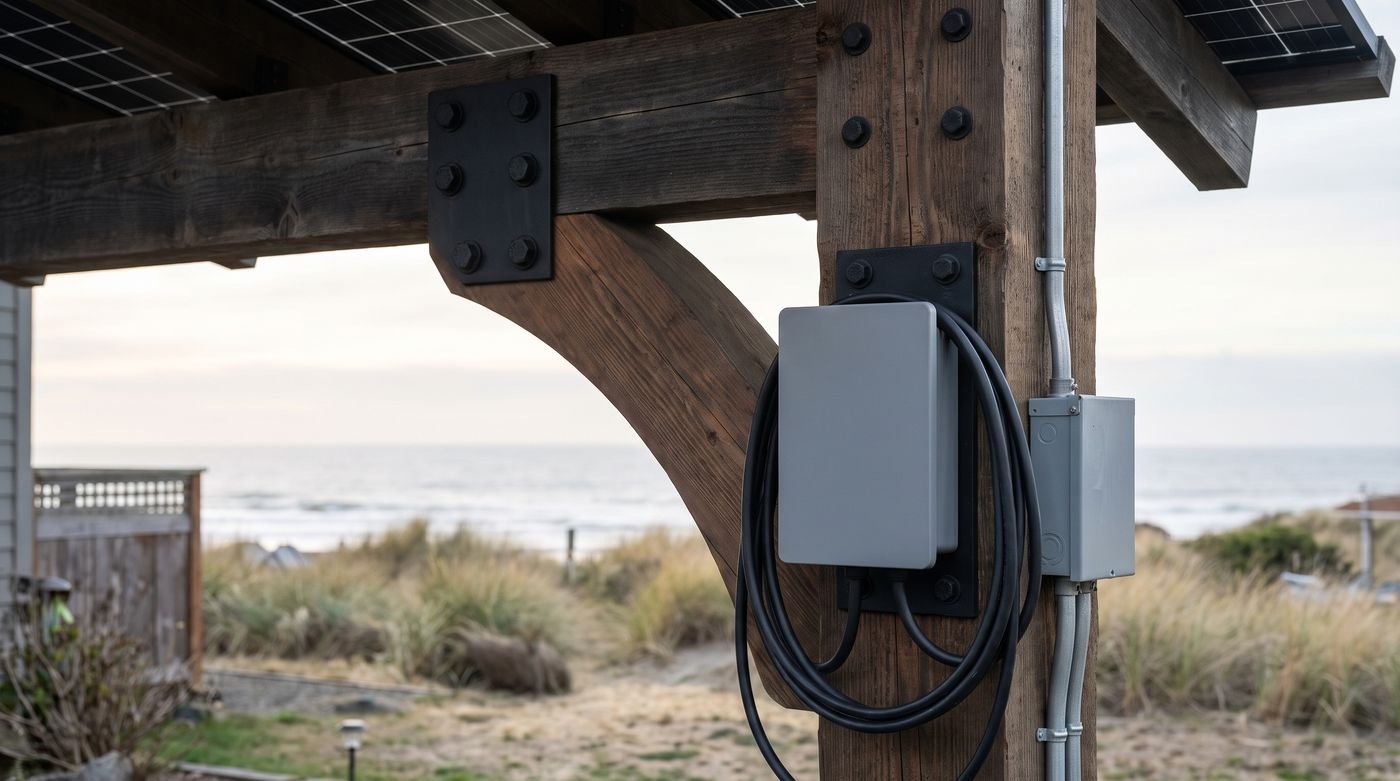
An ordinary EV charger only pushes power into the car. A two-way charger — the industry calls it bidirectional — can also pull power back out. When it feeds your house, that's called vehicle-to-home.
It works with a transfer switch: a device that disconnects your house from the power lines before the vehicle takes over. That protects line crews working on the grid and keeps your house from trying to power the whole neighborhood. More on two-way chargers →
4. Why the carport keeps working in an outage
Most home solar shuts itself off when the grid goes down. It's a safety rule, and it surprises plenty of owners in their first hurricane. A Bugging Out carport is planned around backup from the start, so the sun can keep topping up your vehicle while the grid is out. That's what turns a few days of backup into an open-ended one.
What to have ready
- A vehicle that supports two-way power (see which ones).
- The maker's approved two-way charger and home kit, if it needs one.
- A licensed electrician for the transfer switch and panel work.
- Your local permit — carports and solar both usually need one.
Ready when the lights go out
Tell us about your place and what you drive. We'll tell you straight what a Bugging Out carport would do for you.