Scout home backup
How a Scout carries your house through an outage, step by step — and how the sun keeps it going.
What makes it possible
Scout Motors has announced bidirectional charging for the Traveler and Terra: power that flows out of the battery as well as in. Paired with a two-way home charger and a transfer switch, that lets a Scout run your house.
Bugging Out Solar is independent and not affiliated with Scout Motors. Vehicle facts are as Scout has announced them and can change before the trucks reach customers.
The outage, step by step
- The storm is coming. The Scout is already full from the solar roof.
- The grid drops. The transfer switch disconnects your house from the power lines, so nothing feeds back onto lines crews are repairing.
- The Scout takes over. Through the two-way charger, it powers the circuits you've chosen: fridge, freezer, well pump, lights, fans, internet.
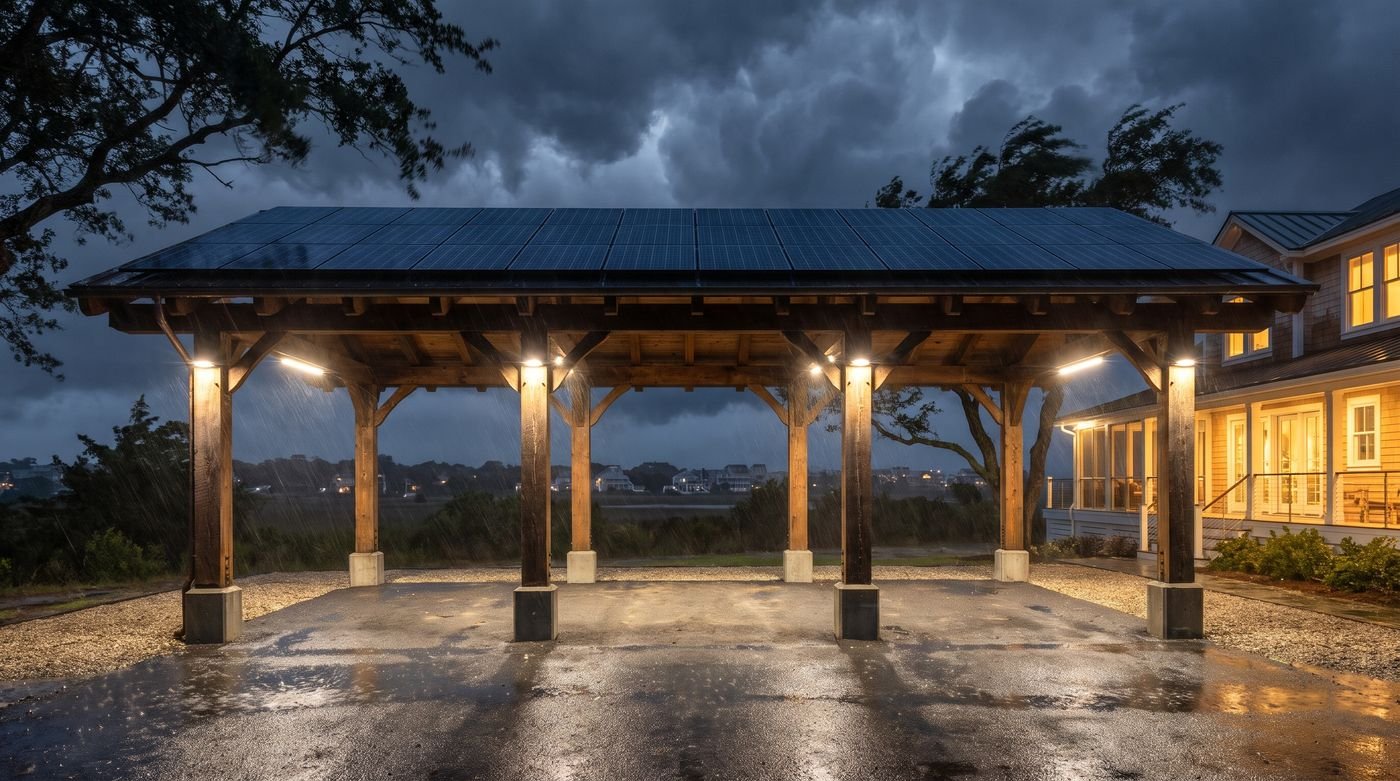
- The sun comes back out. The carport, built to keep working with the grid down, tops the Scout back up.
- Or you leave. Unplug and go, fully charged.
How long will it last?
The average American home uses about 29 kWh a day (U.S. Energy Information Administration, 2024). A full-size electric truck battery holds roughly 100 kWh. That's a couple of days of normal living, or a week or more on essentials — and a sunny day on the carport adds back around 30 kWh.
Estimates. Scout hasn't published final battery sizes; your house, your season and your habits set the real numbers.
What you'll need
- The two-way home charger Scout approves when it announces one.
- A transfer switch installed by a licensed electrician.
- A solar roof built to keep charging during an outage. Most rooftop solar shuts itself off when the grid goes down; ours is planned around backup.
Ready when the lights go out
Tell us about your place and what you drive. We'll tell you straight what a Bugging Out carport would do for you.