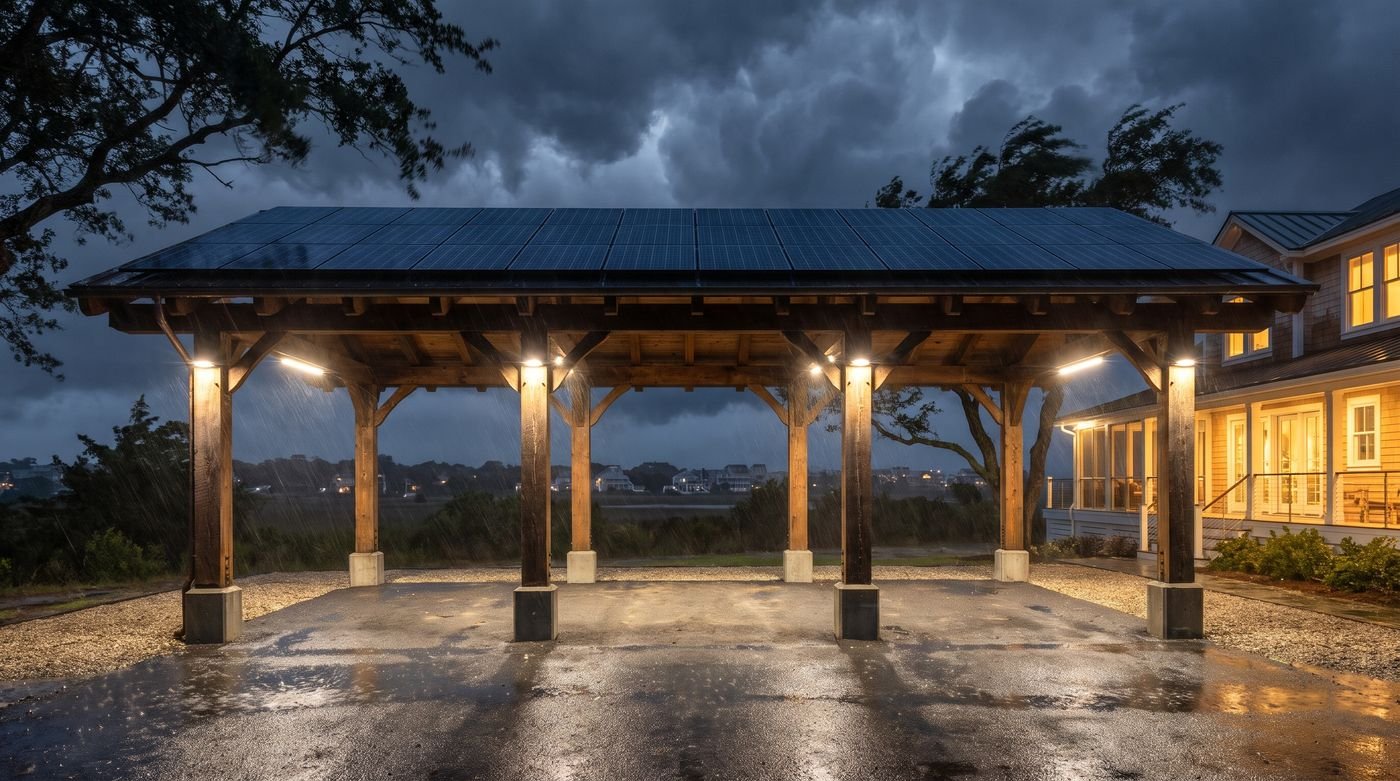
Off-grid power for a self-sufficient home
Making your own power is half of it. Keeping it when the grid is down is the other half.
The catch with ordinary solar
Most rooftop solar systems are tied to the grid and shut off when the grid goes down. That's on purpose: it keeps power from flowing onto lines that repair crews are working on. So a house with panels on the roof can still sit dark in a storm.
Off-grid power needs two more things: a way to separate the house from the grid, and a battery to hold power for nights and cloudy days.
Islanding, in plain words
Islanding means your house runs on its own power while it is cut off from the utility. A transfer switch or home hub makes that cut. Then the solar roof and the battery run the house as their own little grid.
The truck is the battery
| Storage | Typical capacity |
|---|---|
| Wall-mounted home battery | About 13.5 kWh |
| Full-size electric pickup | About 100 to 200 kWh |
| Average U.S. home, one day | About 29 kWh used |
Home use: U.S. Energy Information Administration, 2024. Truck capacities vary by model; see which trucks can power a house.
One electric truck holds as much as seven to fifteen home batteries. Under a solar roof that adds around 30 kWh on a sunny day, the house can run on its own for a long time, especially on essentials.
Grid-tied with backup, or fully off-grid?
Most people stay connected. The grid covers the ordinary days and the carport takes over when the grid fails. A fully off-grid home works too, but plan for the days the truck is out and the stretches without sun, with more panels, a stationary battery, or a range-extended truck that carries its own generator.
What to plan for
- Your daily use: check a year of power bills for your kWh per day.
- Your essentials: fridge, freezer, well pump, lights, fans, internet.
- Your big loads: heat strips, dryers, ovens and well pumps starting up all at once.
- A licensed electrician, a permit, and the automaker's approved two-way charger.
Off-grid questions
Does regular rooftop solar work in a power outage?
Usually not. Most grid-tied solar systems shut down when the grid goes down, by design, so they don't send power onto lines that crews are repairing. To keep running in an outage, a system needs equipment that separates the house from the grid and a battery to store power.
Can a house be fully off-grid with a solar carport and an electric truck?
It can run off-grid for long stretches. How long depends on how much the house uses, how sunny it is, and whether the truck has to leave. Most owners stay connected to the grid and use the carport as their own power plant when the grid fails.
Is an electric truck better than a home battery?
It holds far more. A full-size electric truck stores about 100 to 200 kWh. A typical home battery holds around 13.5 kWh. The truck can also drive away, so plan for the days it's gone.
What is islanding?
Running your house on its own power while it is cut off from the utility grid. A transfer switch or home hub makes the cut so your power can't flow back onto the lines.
Ready when the lights go out
Tell us about your place and what you drive. We'll tell you straight what a Bugging Out carport would do for you.