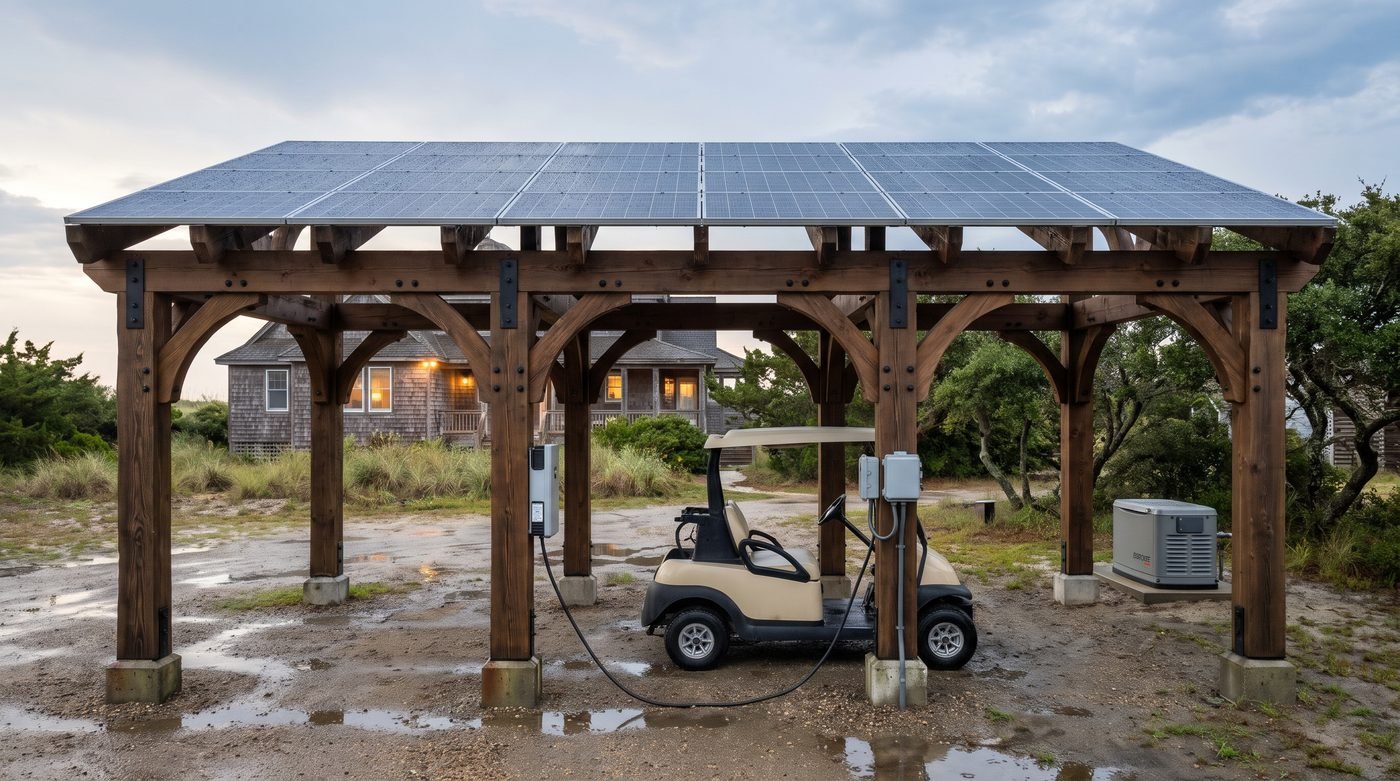
Your buggy is a backup battery
Keep the fridge cold and the lights on from the golf cart in the driveway. A generator refills it when it runs low.
The battery you already own
Many newer golf carts and beach buggies run on a 48-volt lithium battery that holds about 5 kWh. Some hold more. That's a third of a typical wall-mounted home battery, and it's already sitting in your driveway, paid for.
On its own, 5 kWh won't run a whole house. It doesn't have to. In an outage, what matters is the short list: the fridge, the lights, the Wi-Fi, a few fans and your phones.
Battery first, generator second
A whole house generator usually runs from the moment the power drops until it comes back, often at a light load. Pair it with the cart battery and it works differently:
- The cart battery runs the essentials, quietly, through an inverter.
- When the battery runs low, the generator starts.
- For about two hours, the generator runs the house and refills the cart at the same time.
- Then it shuts off, and the battery takes over again.
The generator runs a couple of hours a day instead of all day, with less fuel, less noise and less wear. Two carts in the driveway double the battery.
What a cart battery can run
| Load | Rough use per day | On a 5 kWh cart battery? |
|---|---|---|
| Refrigerator | 1 to 2 kWh | Yes |
| LED lights, Wi-Fi, phones, TV | About 1 kWh | Yes |
| Ceiling and box fans | About 1 kWh | Yes |
| Window air conditioner | 0.5 to 1 kWh per hour | A few hours |
| Central air, heat strips, water heater, dryer, range | Far more | No |
Typical figures; check the labels on your own appliances. The essentials together come to roughly 3 to 4 kWh a day, so a 5 kWh cart covers about a day before the generator needs to run.
How it hooks up
- A 48-volt inverter/charger turns the cart's battery power into 120/240-volt house power. Off-grid models such as the EG4 6000XP make about 6,000 watts and have a separate input for a generator.
- A heavy cable with a quick-connect plug at the carport post, plus a fuse and a shut-off, runs to the cart battery. Park, plug in, done.
- A transfer switch or a critical-loads panel cuts the house off from the grid and feeds just the circuits you choose.
- The generator plugs into the inverter's generator input, not straight into the house.
This isn't a boxed product. It's built from standard off-grid parts, and it needs a licensed electrician and a permit.
The sun makes it better
Under a solar carport, the roof refills the cart on sunny days, so the generator may not have to start at all. A small solar roof on the cart itself, about 200 to 400 watts, adds roughly 1 kWh on a sunny day. Meet Solar Buggies →
Leave enough to drive
Set the inverter to stop while there's still charge left in the cart. Then the buggy still gets you to the store, the neighbor's or the gas station after the storm.
Cart, truck or generator?
| Golf cart battery | Electric truck | Whole house generator | |
|---|---|---|---|
| Stored power | About 5 to 10 kWh | About 100 to 200 kWh | None; burns fuel as it goes |
| Runs | Essentials | Most of the house | The whole house |
| Noise | Silent | Silent | Loud while running |
| Best use | Quiet hours and nights | Days of backup | The refill, and the big loads |
They work best together. The truck or cart carries the house, and the generator becomes the refill, not the whole plan. How a truck powers a house →
Golf cart backup questions
Can a golf cart battery power a house?
Not the whole house, but it can run the essentials. A typical 48-volt lithium golf cart battery holds about 5 kWh. Through an inverter and a transfer switch it can run the fridge, lights, Wi-Fi, fans and phone chargers for about a day. It can't run central air, an electric water heater, a dryer or a range.
What do I need to hook a golf cart to my house?
A 48-volt inverter/charger that makes 120/240-volt house power, a fused disconnect and a heavy cable to the cart battery, and a transfer switch or critical-loads panel so the house is cut off from the grid while it runs. A licensed electrician should install it, with a permit.
How does the generator fit in?
The generator plugs into the inverter's generator input. When the cart battery runs low, you start the generator for a couple of hours. It runs the house and refills the cart at the same time, then you shut it off and the battery takes over again, quietly.
How long does a generator take to refill a golf cart battery?
About two hours for a 5 kWh pack charged at around 55 amps, which is a common continuous charge rating for 48-volt lithium cart batteries. Check your battery's spec sheet; some allow faster charging and some slower.
Will this hurt my golf cart battery?
Lithium iron phosphate cart batteries are commonly rated for thousands of charge cycles, so occasional outage use is light wear. Set the inverter to stop well before the battery is empty so you can still drive the cart. Ask the battery maker whether a direct hookup affects the warranty.
Is this safer than running a generator all day?
It means the generator runs a couple of hours instead of all day, so less fuel, noise and exhaust. A generator still has to sit outside, away from windows, doors and the carport, because exhaust carries carbon monoxide.
Ready when the lights go out
Tell us about your place and what you drive. We'll tell you straight what a Bugging Out carport would do for you.