Battery in the
carport?
Yes, and in a lot of ways it is the best place for it. Here is where the code lets a home battery go, and what changes outside.
Where the code lets a battery go
The national model code for houses (the International Residential Code, section R328 in recent editions) ranks the places a home battery can go, from tightest to loosest. Local versions differ, but the order is the same.
| Location | Typical limit | What it takes |
|---|---|---|
| Inside the house (utility closet, basement) | About 40 kWh | Fire-rated drywall; never in or opening into a bedroom |
| Attached garage | About 80 kWh | Fire-rated wall to the house; heat alarm tied to the smoke alarms |
| Outside wall of the house | 80 to 100 kWh or more | At least 3 feet from doors and windows into the house |
| Detached garage, carport-type structure, or the ground away from the house | 80 kWh, up to 600 kWh in some versions | The loosest rules; more room the farther from the property line |
Limits shown are from local versions of the code in California and Colorado. Your state's version and your local inspector decide. Whether an open carport counts as a "detached accessory structure" is a question for your inspector.
North Carolina right now
North Carolina is still enforcing its 2018 building code. The 2024 code was delayed by the state's hurricane recovery law; it takes effect 12 months after the State Fire Marshal certifies it's ready, which one town reads as sometime after March 2027. The battery section above was added to the national code after 2018, so today North Carolina installs are guided mainly by the electrical code and your inspector. Expect rules like the table once the new code arrives.
Why the carport is a good place for it
- The risk stays out of the house. If a battery ever fails, it fails in an open structure, not under the bedrooms. That's why codes are loosest for detached locations.
- No fire-rated walls, no alarm tie-in. Those rules are for attached garages and rooms inside.
- Room to grow. Detached locations get the biggest size allowance, so adding battery later is less likely to hit a cap.
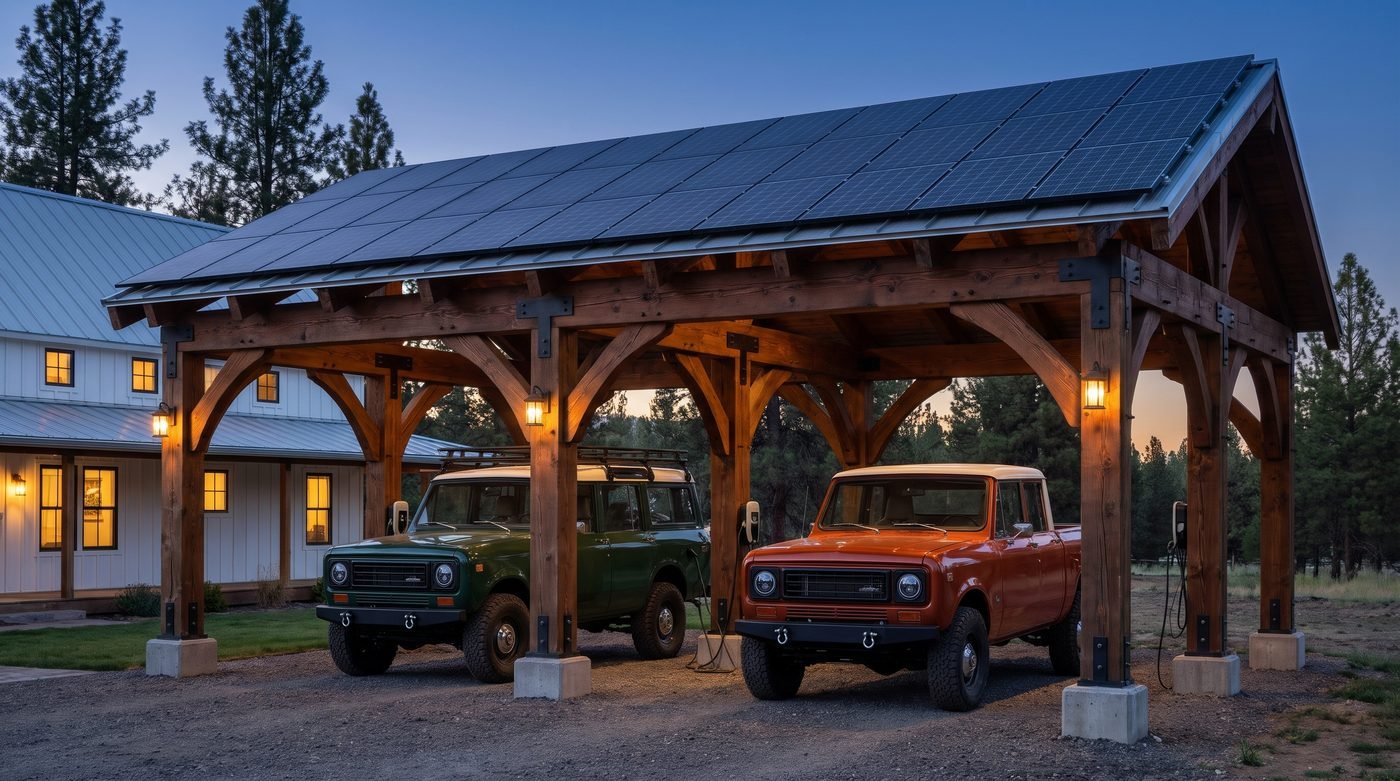
- Short wires. Panels on the roof, inverter and battery on the posts, the truck or cart parked underneath and charging.
- Very little work inside the house. One cable to the panel and a transfer switch.
What to plan for
- A building permit, too. A wall battery needs an electrical permit. A carport is a structure, so it also needs a building permit and engineering.
- The run to the house. Power has to get from the carport to your panel, usually by trench. The closer the carport, the cheaper.
- Bumpers. Codes require posts or wheel stops where a vehicle could hit the battery, unless it's mounted at least 48 inches up. Under a carport, mount it high.
- Heat, cold and salt. Use outdoor-rated equipment in a shaded, sealed enclosure. Lithium iron phosphate batteries won't charge below freezing without a heater, and they age faster in summer heat.
- Flood zones. Mount the gear above your lot's flood elevation. Hurricane-rated carports →
- Theft. Lockable enclosures.
Tell us your size and your site
Which kit, where it's going, and what you'll park or put under it. We're putting the first kits together now.
We answer every message ourselves.
Straight answers
Can I put a home battery in a carport?
Generally yes. Model building codes treat detached structures and outdoor locations most loosely. Mount the battery at least 48 inches up or behind a barrier so a vehicle can't hit it, and use outdoor-rated equipment. Your local inspector makes the call on whether an open carport counts as a detached structure.
Is it safer to keep a home battery outside the house?
That's the reason codes are loosest for detached and outdoor locations: if a battery fails, it fails away from where people sleep.
Does North Carolina have battery location rules?
North Carolina is still on its 2018 building code, which predates the national battery-location section. Installs are guided mainly by the electrical code and the local inspector until the 2024 code takes effect.
How high should a battery be mounted in a garage or carport?
Model codes consider a battery at least 48 inches above the floor out of reach of vehicles. Lower than that, it needs bollards or wheel stops.
Can a lithium battery sit outside in winter?
It can, in an outdoor-rated enclosure, but lithium iron phosphate cells can't charge below 32°F without a built-in heater. Many outdoor models include one. Sodium-ion batteries handle cold better. More on battery types.