Solar pool
heater
Pool water heated by the sun instead of the power bill. How solar pool heating works, how much collector it takes, and where a pool house roof fits in.
In short: a solar pool heater sends pool water through collectors in the sun and back to the pool, using the pool pump you already run. The U.S. Department of Energy says the collectors should cover about 50% to 100% of the pool's surface area, puts a typical system at $2,500 to $4,000 installed, and estimates it pays for itself in 1 to 7 years, depending on local fuel costs and sunshine.
How a solar pool heater works
A solar pool heater has four parts: the collectors, the pool filter, the pool pump and a valve. Water leaves the filter, runs through the collectors, picks up heat and goes back to the pool. A sensor sends water up to the collectors only when they are warmer than the pool. When they aren't, the water skips them.
In the hottest weeks of summer it can run the other way: water sent through the collectors at night gives off heat and cools the pool.
Two kinds of collectors
| Unglazed | Glazed | |
|---|---|---|
| What it is | UV-treated rubber or plastic, no glass | Copper tubing on an aluminum plate under tempered glass |
| Cost | Lower | Higher |
| Best for | Pools used only in warm weather | Cooler weather and longer seasons; can also heat household hot water |
Both need freeze protection if they will see freezing weather. Rows of glass tubes are another glass-covered type that holds heat well when the air is cool.
How much collector a pool needs
The Department of Energy's rule of thumb is collector area equal to 50% to 100% of the pool's surface area. Cooler or cloudier places need the higher end. A pool cover lowers the number, because the pool loses less heat overnight.
| Example | Pool surface | Collector area |
|---|---|---|
| 15 x 30 ft pool, swimming all year in Florida (DOE example) | 450 sq ft | About 450 sq ft (100%) |
| Pool used 6 to 8 months a year in northern California (DOE example) | — | About 60% to 70% of the pool |
| 16 x 32 ft pool | 512 sq ft | About 256 to 512 sq ft |
Where a pool house roof fits in
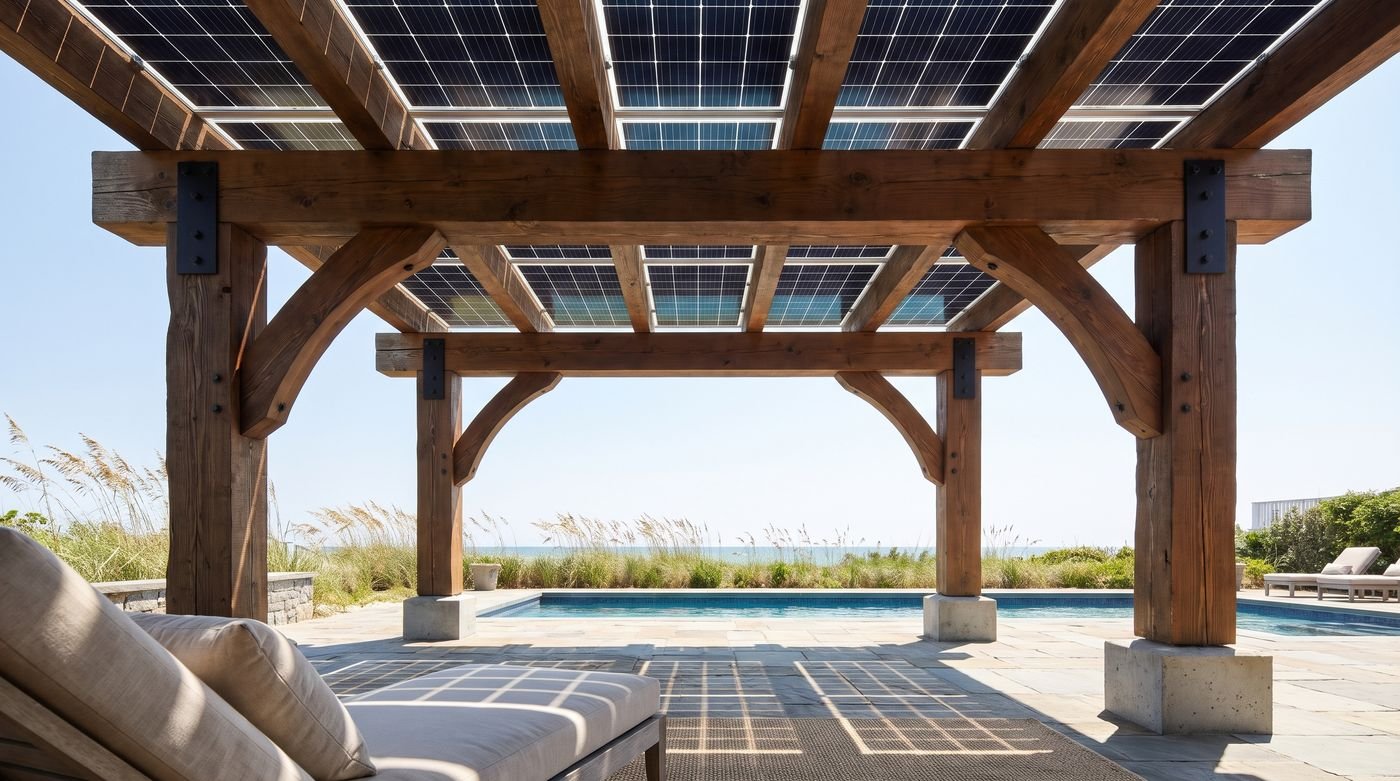
An open-air timber frame pool house of about 16 by 20 feet has a 320-square-foot roof. We split that roof between solar panels, which run the pump, the lights and the equipment, and solar thermal collectors, which heat the water. Turning sunlight straight into heat captures more of the sun's energy than turning it into electricity, so for heating, square foot for square foot, thermal wins.
Here is the honest part: the thermal share of one pool house roof is well short of 50% of an average pool. On its own it takes the chill off and stretches the swim season into spring and fall, especially with a pool cover. To heat a larger pool fully with the sun, the rest of the collectors go on a nearby roof or a ground rack, plumbed into the same loop.
The plumbing is easy because the pool sits right beside the roof. The run is short, and the pump the sun is already running pushes the water through the collectors.
Which way to face it, and how steep
Facing true south is best, and collectors can face up to 45 degrees east or west of south without losing much. For heating only in the warm months, tilt them at your latitude minus 10 to 15 degrees; for year-round heating, tilt them at your latitude. Flat mounting usually works too.
On the Outer Banks, at about 36 degrees north, the warm-season range works out to about 21 to 26 degrees. A 5-in-12 roof, the pitch of our standard gable roof, is 22.6 degrees, which lands right in it.
Cost, life span and what to look for
The Department of Energy puts a typical system at $2,500 to $4,000 installed, with payback in 1 to 7 years. It calls solar pool heating cost-competitive with gas and heat pump heaters, with very low running costs, and says the systems usually last longer than either: 10 to 20 years with proper care.
When you compare collectors, look for ones certified by the Solar Rating and Certification Corporation (SRCC) under its OG-400 standard for solar pool heaters.
Timber frame pool house → Hot tub gazebo → Solar pergola →
Source: U.S. Department of Energy, Solar Swimming Pool Heaters.
Straight answers
How does a solar pool heater work?
The pool pump sends water from the filter through solar collectors, where it picks up heat, and back to the pool. A sensor and valve send water to the collectors only when they are warmer than the pool.
How many solar collectors do I need for my pool?
The U.S. Department of Energy's rule of thumb is collector area equal to 50% to 100% of the pool's surface area, toward the high end in cooler or cloudier places. A pool cover lowers the number.
How much does a solar pool heater cost?
The Department of Energy puts a typical system at $2,500 to $4,000 installed, with payback in 1 to 7 years depending on local fuel costs and sunshine.
How long does a solar pool heater last?
With proper care, 10 to 20 years, which the Department of Energy says is usually longer than gas and heat pump pool heaters.
Can a pool house roof heat my pool?
Part of the way. The thermal share of one pool house roof is well short of half an average pool's surface, so on its own it takes the chill off and stretches the season, especially with a pool cover. Full solar heat needs more collectors on a nearby roof or a ground rack.
Which direction should solar pool collectors face?
True south is best, and up to 45 degrees east or west of south loses little. Tilt them at your latitude minus 10 to 15 degrees for warm-season heating, or at your latitude for year-round heating.
Tell us about your pool
The size of the pool, where the sun hits and how long you want to swim. We'll tell you straight what the roof can heat and what it can't.