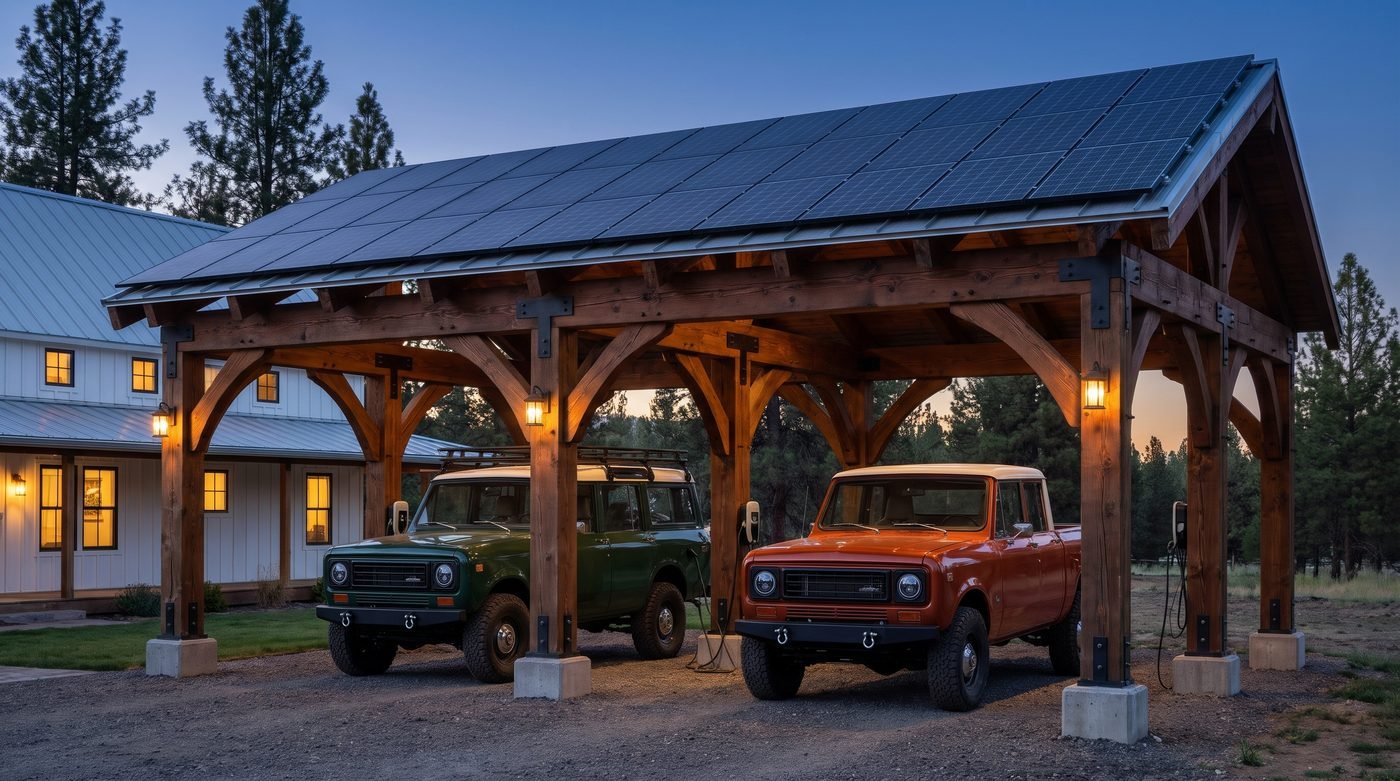
Home battery
backup
Big, heavy and finally cheap. What's inside a home battery now, what's coming next, and why one belongs on a carport post.
Why a stationary battery at all?
The truck is the big reserve. A full-size electric pickup carries roughly 100 kWh, enough to run a house for days. But the truck leaves. It goes to work, to the beach, to the store. A battery bolted to the carport is there every hour of every day, so the house has power whether or not anything is parked underneath.
It also does a job the truck can't: it works the daily cycle. The panels fill it while the sun is up. It tops off from the grid overnight, when power is cheapest. Then it carries the house through the expensive evening hours. That's not a storm feature. That's every day. How it lowers your power bill →
What's in a home battery today
The chemistry that won is lithium iron phosphate, usually written LFP. It's not the lithium in your phone or in most EVs. It's heavier, it holds a little less energy per pound, and none of that matters when the battery sits on a post and never moves. What does matter: it's far harder to set on fire, and it's rated for thousands more charge cycles. Manufacturers rate LFP home batteries at 6,000-plus full cycles, which is 15 years and more of charging and draining every single day.
And it has gotten cheap. BloombergNEF's 2025 survey put the average lithium battery pack at $108 per kWh, down 93 percent since 2010. Packs built for stationary storage, the kind that goes in a house, came in at about $70 per kWh, down 45 percent in one year and now the cheapest category of battery made. At retail, a 14 kWh wall-mounted LFP battery runs around $5,500 for the battery alone, and a complete 30 kWh system with the inverter is in the $10,500 to $14,500 range in equipment before an electrician's labor. Ten years ago that was a luxury. Now it's a line item next to the panels.
Prices are 2026 US market figures from manufacturers and distributors and change often. Battery ratings are the makers' claims.
What's coming: sodium-ion
The next chemistry doesn't use lithium at all. Sodium-ion batteries are built on salt, which is everywhere, cheap, and not controlled by any one country. CATL, the world's largest battery maker, showed a sodium-ion storage cell in April 2026 rated for more than 15,000 cycles at 80 percent capacity, operating from 40 below zero to 158°F, with no thermal runaway in nail, crush or overcharge tests. It says commercial deployment starts in 2026, aimed first at utility-scale storage. In the U.S., Colorado-based Peak Energy has a sodium-ion plant near Sacramento slated for 2027, and its grid batteries are rated for about 20,000 cycles over 20 years.
For the house, the first sodium-ion product you can actually buy is a portable: Bluetti's Pioneer Na, a 900 Wh power station that still delivers 80 percent of its capacity at 13 below zero. Wall-mounted sodium-ion home batteries are the obvious next step, and the industry's own projections put them in the 2027 range, with cell cost matching LFP around the end of 2026.
How big?
The average American home uses about 29 kWh a day (U.S. Energy Information Administration, 2024). Think of the stationary battery in three sizes:
| Battery | What it carries | Who it's for |
|---|---|---|
| 15 kWh | The evening peak, plus the essentials overnight in an outage: fridge, freezer, well pump, lights, internet. | A house that also has a two-way truck for the long haul. |
| 30 kWh | A normal day's use. Charges at night, runs the house all evening, full backup for a day on its own. | Most homes. The size where the night-rate math gets interesting. |
| 45 kWh+ | A day with margin, or two days on essentials, before the truck or a small generator is even asked. | Big houses, well pumps, workshops, anyone who wants to forget the grid exists. |
Add the truck's roughly 100 kWh on top of any of these and you're into a week of essentials. Run your own numbers →
Where it goes
LFP batteries charge best between about 32°F and 113°F, so the bay is on the shaded north side of the carport, under the roof, off the ground, in a lockable cabinet built from the same timber. The hybrid inverter (the box that moves power between the panels, the battery, the grid, the truck and the house) hangs beside it. Conduit runs to the house in one trench. Nothing in the garage, nothing on the house wall.
How the outage plays out → Two-way chargers → Carport vs. generator →
Batteries make the news when companies fail, too. The fallen stars of American solar → covers Natron, Powin, Ambri and the rest, and what to do if you own one of their systems.
Ford Fathom vs. Tesla Powerwall: which is cheaper home backup? →
Straight answers
Is a lithium battery on a wooden carport safe?
LFP is the chemistry chosen for home storage precisely because it resists catching fire. Units are UL-listed, and the bay is built to code with the clearances the listing calls for. Sodium-ion, when it arrives, removes the question almost entirely.
Should I wait for sodium-ion?
Build the carport now; it's the slow part. LFP is cheap and proven today, and the bay takes either battery. If sodium arrives on schedule, your first battery swap is a decade or more out anyway.
Do I still need the truck?
No. A 30 kWh stationary battery runs a house on its own. The truck turns a day of backup into a week, and it's the part that can drive away full when you decide to leave.
Does the battery work when the grid is down?
Yes. That's the design. Most rooftop solar shuts itself off in an outage; a battery with a hybrid inverter and a transfer switch keeps the panels charging and the house running.
Size the battery for your place
Tell us what you want to keep running and what you drive. We'll tell you straight what size makes sense.