Home backup
compared
Generators, wall batteries, roll-around power stations and trucks that power the house. What each costs, and what each one does for you.
There are four ways to keep the lights on when the grid goes down. A generator burns fuel. A battery stores power. A power station is a battery on wheels you roll next to the panel. And a growing list of trucks can power the house from their own battery. Here's the whole field in one table.
The options
| Option | Storage / output | Price as listed | Needs fuel? | Lowers your bill? |
|---|---|---|---|---|
| Portable generator (Westinghouse 9,500W dual-fuel) | 9,500 W running on gas | $1,149.99 | Yes | No |
| Standby generator (Generac Guardian 22 kW with transfer switch) | 22 kW | $7,229 equipment; about $10,000 to $14,000 installed (2025 figure) | Yes, natural gas or propane | No |
| Tesla Powerwall 3 | 13.5 kWh / 11.5 kW | About $13,473 installed, typical | No | Yes, with solar or a time-of-use rate |
| EG4 wall battery + 18kPV inverter | 14.3 kWh per battery / 12 kW | About $3,455 battery + $3,999 inverter, before install | No | Yes, with solar or a time-of-use rate |
| EcoFlow Delta Pro Ultra | 6 kWh / 7.2 kW, grows to 90 kWh | $4,099 base; Smart Home Panel 2, $1,599 | No | Some, with solar |
| Anker Solix E10 | 6.1 kWh per battery / 7.7 kW | From $4,299; $7,799 with Power Dock, 2 batteries and automatic backup | No | Some, with solar |
| Bluetti Apex 300 | 2.8 kWh / 3.8 kW, grows to 58 kWh | $1,499; $3,199 with extra battery and home backup kit (sale price) | No | Some, with solar |
| GM truck-to-home (PowerShift charger + V2H kit) | Your truck's battery | $8,098 hardware, install extra | No | Not today |
| Tesla Cybertruck Powershare | Your truck's battery | $1,970 bundle, install extra | No | Not today |
| Ford + GenerLink (F-150 Lightning, PowerBoost) | Your truck; "up to five days" | About $1,350 to $1,550 installed | Hybrid uses gas | No |
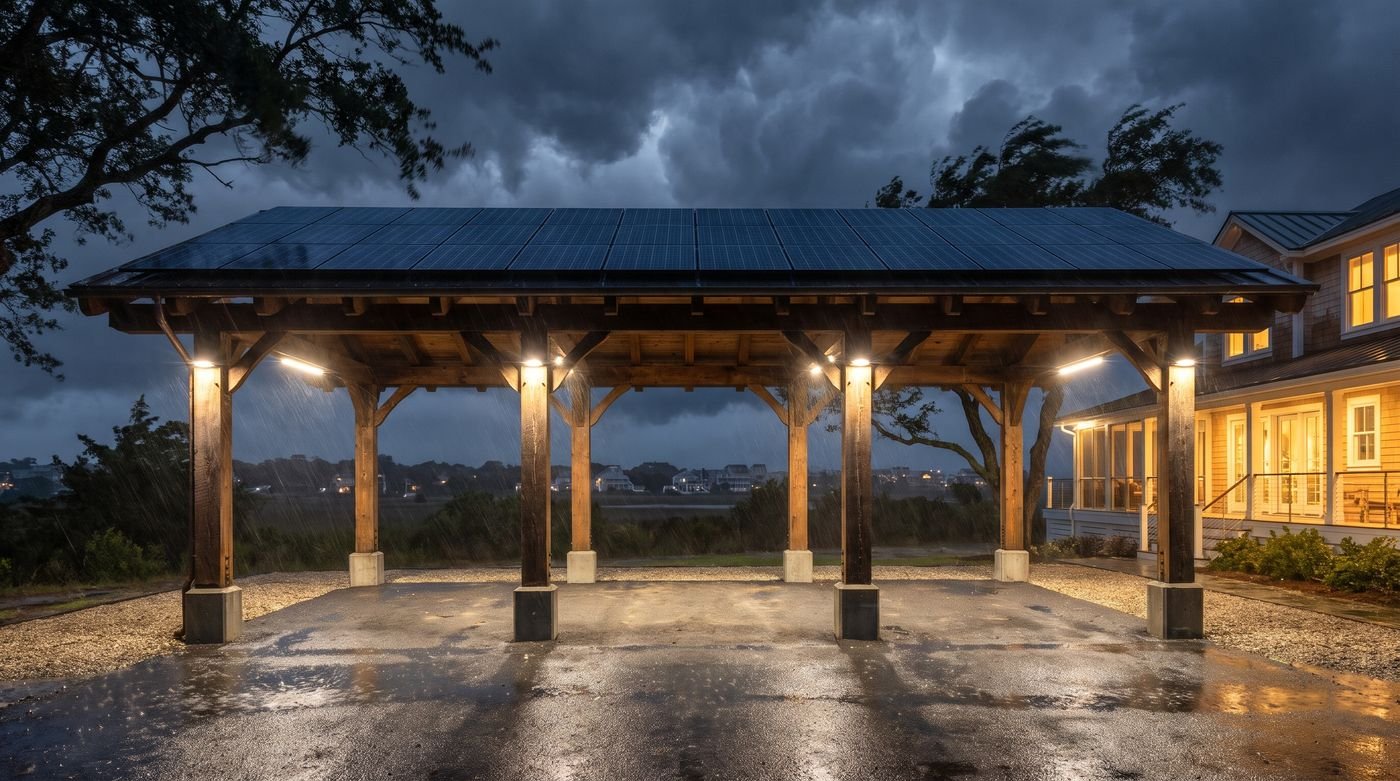
| Solar carport + battery | Sized to your house | Quoted for your site | No | Yes, every day |
Prices as listed by sellers in November 2026; some are sale or retailer prices, and the Generac installed range is from a 2025 estimate. Brand names belong to their owners. We are not affiliated with any of them.
The real difference: does it pay you back?
A generator is insurance. It sits in the yard, needs fuel and oil changes, and does nothing for you until the lights go out. Everything with a battery can do a second job: soak up cheap power at night or free power from the sun, and run the house when power is expensive. That's the difference between a cost and something that pays you back. Where a home battery pays the most →
How to choose
- Short outages, tight budget: a portable generator still wins on price.
- Long outages, no hassle: a standby generator, or a big battery with solar to refill it.
- Lower bill plus backup: a wall battery on a time-of-use rate, or a solar carport with a battery under it.
- You already own an EV truck: a truck-to-home kit is the cheapest storage you'll ever buy. Pair it with a solar roof and it refills itself. Vehicles that can power a house →
- Renters and small spaces: a roll-around power station.
Solar carport vs. generator
| Portable gas generator | Solar carport + electric 4x4 | |
|---|---|---|
| Fuel | Gas you store and refill, often in the storm | The sun, plus what's already in the battery |
| Running it | Outside, in the weather, away from windows | Switches over at the panel; nothing runs in the yard |
| Noise and fumes | Loud; exhaust carries carbon monoxide | Quiet; no exhaust |
| How long it runs | As long as you have gas | About 3 days normal use, a week or more on essentials, refilled by sun |
| The other 360 days | Sits in the shed | Charges your daily driving and shelters two full-size trucks |
| If you have to leave | Stays behind | Drives you out, full |
Where a generator still makes sense: it’s cheaper up front and works with any car in the driveway. If you don’t drive an electric vehicle, or don’t plan to, it’s the simple choice, and a standby generator on natural gas or propane avoids the gas-can problem.
Where the carport wins: if an electric truck or SUV is in your future, you’re already buying the battery. The carport adds the sun and the hookup, and the setup earns its keep every day instead of only during storms. No electric truck? A golf cart battery can run the essentials, and a generator refills it in a couple of hours instead of running all day.
Hurricane season on the coast
On the Outer Banks and around Hampton Roads, losing power for days isn’t a what-if. The fridge and freezer go first, then water if you’re on a well, then fans or A/C in the heat. Salt air, sand and hurricane winds also set the bar for anything built outside: a carport here has to be engineered for local wind loads (hurricane-rated carports →).
- Keep the vehicle or battery charged when a storm is in the forecast.
- Know which circuits you’ll run: fridge, freezer, well pump, lights, fans, internet.
- Test the switchover before storm season, not during the storm.
- Have a plan for leaving, and a full battery to do it. Bug in or bug out →
How much do you need? The backup power calculator works it out.
Tell us your size and your site
Which kit, where it's going, and what you'll park or put under it. We're putting the first kits together now.
We answer every message ourselves.
Straight answers
Is a Powerwall better than a generator?
They do different jobs. A generator only helps in an outage and needs fuel. A Powerwall stores about 13.5 kWh and, with solar or a time-of-use rate, lowers your bill every day. It costs about $13,473 installed, typically, against roughly $10,000 to $14,000 for an installed 22 kW standby generator.
How much does EcoFlow Delta Pro Ultra cost?
The base unit, with 6 kWh of storage and 7.2 kW of output, was listed at $4,099 in November 2026. The Smart Home Panel 2 that connects it to the house was $1,599.
Can my truck power my house?
Several can, with the right hardware: GM EVs with the PowerShift charger and V2H kit ($8,098 hardware), the Cybertruck with Powershare ($1,970 bundle), and the F-150 Lightning or PowerBoost hybrid with GenerLink (about $1,350 to $1,550 installed).
What is the cheapest whole-home backup?
A portable generator with a transfer switch is still the cheapest way to get backup. It does nothing for your power bill, though, and it needs fuel on hand.
Does home backup lower my electric bill?
Batteries can. Generators can not. A battery charged by solar or by cheap overnight power can run the house in the evening, when power costs the most.
Before you sign a 20-year contract with anyone, read the solar companies that went bankrupt → and what happened to their customers.