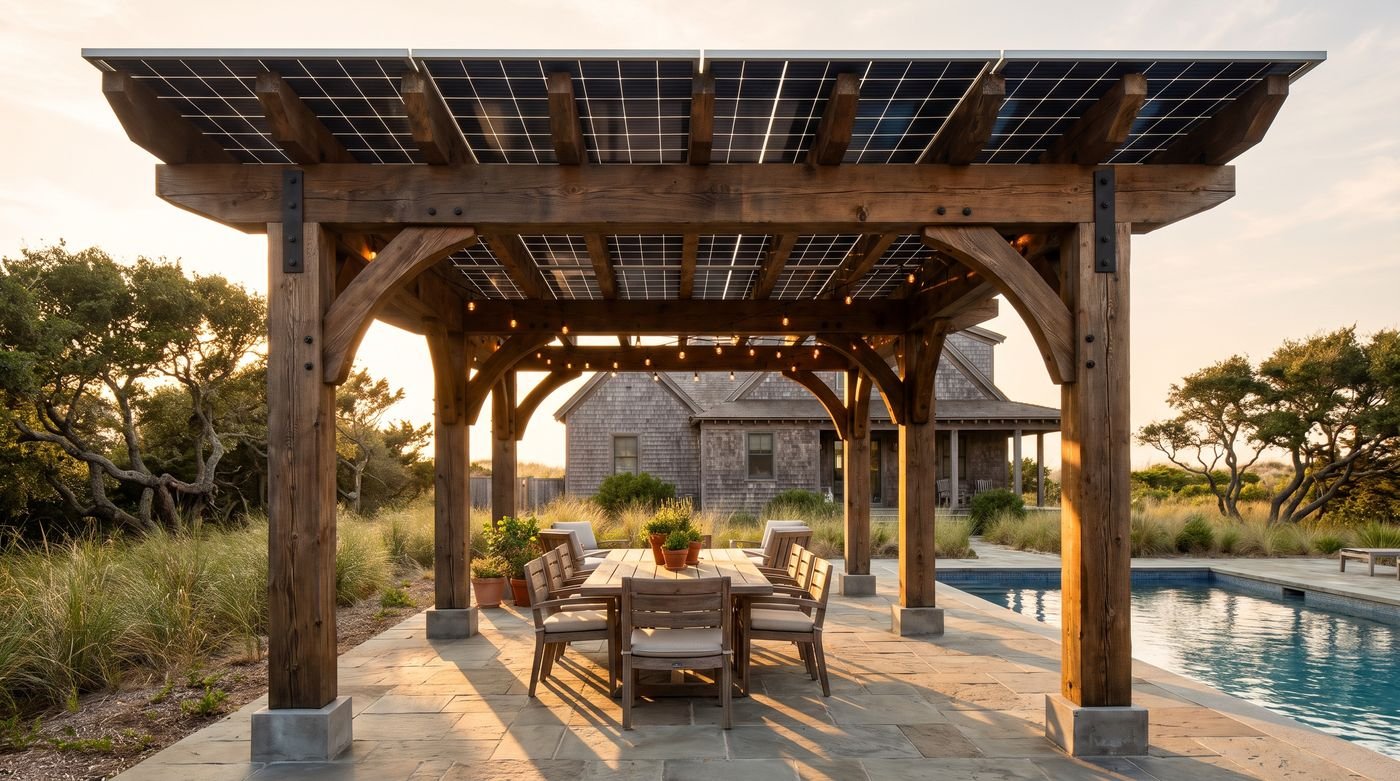
Pool house
microgrid
The street goes dark. Your lights stay on. It starts with a pool house that makes its own power.
Saturday afternoon. The pump is humming, the fridge is cold, the fans are turning and the music is on. All of it is running on the roof over your head, and none of it shows up on a power bill.
That’s where it starts. Where it goes from there is up to you: the house, the truck, the grid. One timber frame, and you add to it when you’re ready.
In short: The pool house starts as its own small power system: a solar roof and a battery running the pool pump, lights, fans, fridge and outlets, with no tie to the house or the grid. Later you can run a line to the house so the pool house carries the essentials in an outage, add a two-way electric vehicle, or connect to the grid to cut the bill. Each step builds on the last.
First, the best seat in the yard
Heavy timber overhead, shade at the water’s edge, and a roof that quietly runs everything at the pool. The sun that warms the deck also runs the pump, makes the chlorine and keeps the drinks cold. It can heat the water too.
For your electrician: the stand-alone stage
- A solar roof and a battery at the pool house, running its own loads: pump, salt chlorine generator, pool lights, ceiling fans, outdoor fridge and outlets.
- No tie to the house panel or the grid. A system that never connects to the power lines doesn’t need the utility’s approval to interconnect.
- It still needs the county’s building and electrical permits. Our stamped plans are drawn for that.
- Battery location: see can a battery go outdoors?
Electricians: spec sheets and one-line diagrams → · pool house electrical rules (NEC 680) →
Then the storm comes, and you barely notice
The grid drops. Your fridge and freezer keep running. The well pump keeps the water on. The lights, the fans and the internet stay up. The next morning the sun comes out and fills the battery back up.
For your electrician: backing up the house
- A line from the pool house battery to a transfer switch or backup panel at the main house.
- When the grid goes down, the switch disconnects the house from the power lines, and the pool house carries the chosen circuits: fridge, freezer, well pump, lights, fans, internet.
- A licensed electrician sets up the transfer switch and the grounding to code, including how the neutral wire is handled where the pool house system meets the house wiring.
- Utility approval: often not needed if the system never feeds the grid, but check with your utility. Some want to review a backup transfer switch.
- The system is built to run with the grid down, so solar keeps refilling the battery during an outage.
- How long it lasts depends on the battery size and the loads. The backup power calculator gives a starting estimate.
Electricians: spec sheets and one-line diagrams → · pool house electrical rules (NEC 680) →
Then the truck joins in
Park under the timbers and the roof fills the tank. And if your vehicle can send power back out, the biggest battery you own is now part of the house.
For your electrician: adding the vehicle
- An EV charger on the timber post lets the roof charge the car.
- Sending power back to the house takes each maker’s own home equipment: a Cybertruck uses Tesla’s Powershare gear, a Model 3 or Model Y needs a Powerwall 3 to back up the house (charging alone needs only a Wall Connector), and GM’s EVs use GM Energy’s kit.
- Utility approval depends on the maker’s equipment.
- See every vehicle that can power a house.
Electricians: spec sheets and one-line diagrams → · pool house electrical rules (NEC 680) →
Then, if it pays, the grid
Hook it up and the same roof starts trimming the house’s power bill. The backup stays ready for the next storm.
For your electrician: tying to the grid
- Connecting to the grid takes the utility’s approval.
- It lowers the house’s power bill, especially where evening power costs more.
- Grid-tied solar shuts off in an outage unless the battery system is built to run the house with the grid down, which is why that kind of battery stays in the plan.
Electricians: spec sheets and one-line diagrams → · pool house electrical rules (NEC 680) →
Nothing gets torn out
The conduit for every later step is planned into the timbers from the start. Adding the house line, the charger or the grid connection doesn’t mean cutting into finished work. See how we hide the lights, fans and outlets in the frame.
All four stages at a glance
| Stage | What you add | What it does | Utility approval? |
|---|---|---|---|
| 1. Stand alone | Solar roof and a battery at the pool house | Runs the pump, salt chlorine generator, lights, fans, fridge and outlets | No |
| 2. Back up the house | A line to a transfer switch or backup panel at the house | Carries the essentials in an outage | Often not, but check with your utility |
| 3. Add the vehicle | An EV charger on the post, and two-way equipment if your vehicle supports it | Charges the car from the roof; some vehicles add their battery to the backup | Depends on the maker’s equipment |
| 4. Tie to the grid | Utility interconnection | Lowers the power bill; backup keeps working through the battery | Yes |
Your electrician and your utility have the final say on equipment and approvals at each stage.
Straight answers
What is a pool house microgrid?
A small power system of its own: a solar roof and a battery at the pool house that make and store power and can run without the grid. It starts by running the pool house and can grow to back up the main house.
Do I need the power company's approval?
Not for the stand-alone stage. A system that never connects to the power lines doesn't need the utility's approval to interconnect. It still needs the county's building and electrical permits. Tying it to the grid later does need the utility's approval, and some utilities also want to review a backup transfer switch.
Can the pool house battery back up my house in an outage?
Yes, once a licensed electrician runs a line from the pool house to a transfer switch or backup panel at the house. Plan on the essentials: fridge, freezer, well pump, lights, fans and internet. How long it lasts depends on the battery size and what you run.
Can I add an electric vehicle later?
Yes. The frame is planned with conduit for a charger from the start. Whether the vehicle can also send power back to the house depends on the maker's own home equipment; see vehicles that can power a house.
Why put the solar on the pool house instead of the house roof?
The space around a pool is usually cleared and wide open to the sun, the pool pump runs during the day when the sun is up, and a separate structure keeps the first stage off the house wiring.
Ready when the lights go out
Tell us about your place and what you drive, or plan to. We'll tell you straight what a Bugging Out pool house or carport would do for you.