
RV carport
A roof tall enough for the rig, strong enough for the storm, and covered in solar panels that pay you back while the RV sits.
In short: Plan about 14 feet of clear height for an RV carport, measured under the lowest knee brace, and a roof about 45 to 50 feet long for a 40-foot rig. A roof that size holds roughly 10 to 13 kW of solar panels, enough to keep a 50-amp RV outlet on one post and, with a battery, back up the house.
Your RV deserves a roof
Sun is hard on an RV. It cooks the roof membrane, dries out the sealant around every vent and window, and fades the paint and decals. Rain finds whatever the sun cracked. A roof over the rig stops most of that before it starts.
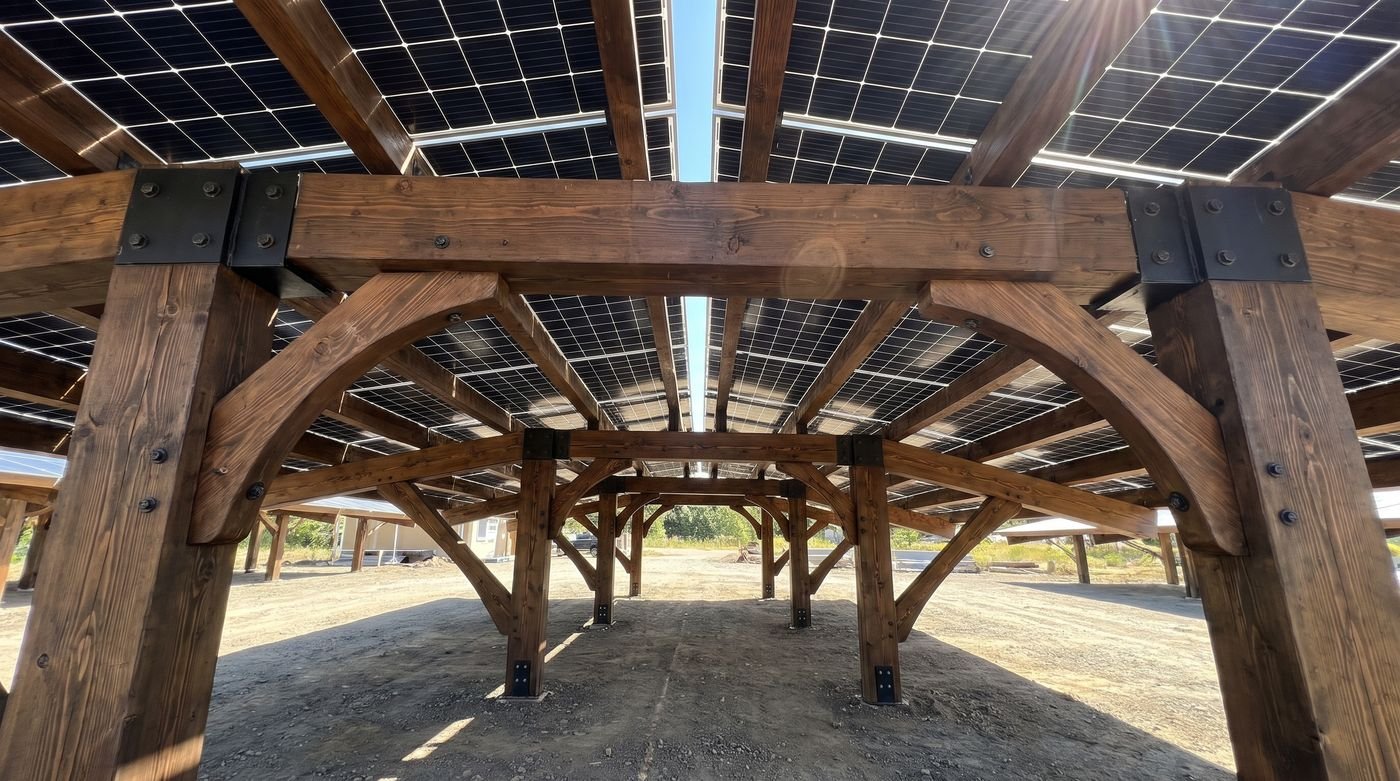
A timber frame RV carport does it with heavy posts and beams instead of a thin steel kit. It looks like it belongs on the property, and it's built to handle wind.
Tall enough, measured the right way
Most RVs stand about 10 to 13½ feet tall, and roof air conditioners and antennas add to that. Plan roughly 14 feet of clear height. On a timber frame, measure under the lowest knee brace, the curved timber between post and beam, not just under the beam. Leave room on the sides for slide-outs and the awning.
For length, measure bumper to hitch and add a few feet so the ends stay dry. A 40-foot rig usually wants a roof about 45 to 50 feet long.
A big roof makes big power
An RV carport is one of the largest roofs on the property, and it's out in the open. A roof about 14 by 45 feet holds roughly 25 to 30 modern solar panels, around 10 to 13 kilowatts. On a sunny day that can make 40 to 60 kilowatt-hours, more than a typical American home uses in a day.
Put a 50-amp RV outlet on one post and the rig stays charged and ready. Add a battery and the same roof keeps the house running when the power goes out.
Built for wind
A tall, open roof catches wind like a sail. That's why the connections, the footings and the bracing are engineered, and why the knee braces matter. They're what keep the frame square when the wind pushes. See hurricane-rated carports for more.
Timber frame carport · Timber frame pergola ideas · Solar carport kits
Every wire hidden: see how we plan the lights, fans and outlets into the frame.
Straight answers
How tall does an RV carport need to be?
Most RVs stand about 10 to 13½ feet tall. Plan roughly 14 feet of clear height, measured under the lowest knee brace, not just the beam, and add room for roof air conditioners and antennas.
How long should an RV carport be?
Measure the rig bumper to hitch and add a few feet. A 40-foot fifth wheel or motorhome usually needs a roof about 45 to 50 feet long to keep the ends out of the rain.
Can I plug the RV into the carport?
Yes. A 50-amp RV outlet on one post lets you run the rig or keep its batteries charged, and on a sunny day the solar roof is making that power.
How much power does an RV carport roof make?
A roof about 14 by 45 feet holds roughly 25 to 30 modern solar panels, around 10 to 13 kilowatts. On a sunny day that can be 40 to 60 kilowatt-hours, more than a typical American home uses in a day.
Does a tall carport need engineering?
Yes. A tall, open structure catches a lot of wind. Engineered connections and footings are what make it pass inspection and stand through a storm.
Tell us about your rig
How tall and how long, and where it parks. We'll tell you straight what a timber frame RV carport would take.