Tacoma Hybrid:
outage power
The Tacoma i-FORCE MAX won’t run a whole house. It doesn’t need to. Keeping one bedroom cool, the food cold and the lights on is a blessing when nobody else has power, and 2.4 kW does that. Here’s what it runs, what it doesn’t, and the add-ons that stretch it.
Last updated November 14, 2026. Toyota doesn’t publish runtime or engine-cycling figures for the outlets; where we use owner tests, we say so.
At a glance
| Item | Tacoma i-FORCE MAX | Source |
|---|---|---|
| Power out | 2,400 watts at 120 volts, outlets in the cabin and the bed | Toyota |
| Which trims | Standard on TRD Pro and Trailhunter; optional on TRD Sport, TRD Off-Road and Limited | Toyota |
| 240-volt outlet | No | Toyota |
| Feeds the house panel | No; extension cords to what you need | |
| Hybrid battery | About 1.87 kWh, nickel-metal hydride | Reported |
| Fuel tank | 18.2 gallons | Toyota spec sheet |
| Engine | Starts and stops by itself to recharge the battery | Owner tests |
How the engine cycles
With the truck on and in park, the hybrid battery carries the load and the engine starts only to recharge it, much like a modern inverter generator. The battery is small, so the engine rests for minutes, not hours. One owner timed it on a 2024 Trailhunter:
| Load | Engine off | Engine on |
|---|---|---|
| 360 watts | About 10 to 17 minutes | About 6 to 7 minutes |
| 1,117 watts | About 8½ minutes | Not timed |
| About 2,380 watts, both outlets | About 5 minutes | About 9 minutes |
The lighter the load, the longer the engine rests. Another owner reported a 10,000 BTU window air conditioner brought the engine on within a minute. Toyota has a “generator mode” on the Trailhunter that tunes this cycling for parked use; one owner’s blog says Toyota plans to bring it to other trims by software update, which Toyota hasn’t confirmed.
Fuel: how long a tank lasts
Toyota doesn’t publish a runtime. XOverland relayed a Toyota engineer’s figure of about 0.76 gallon an hour with the engine running nonstop. On an 18.2-gallon tank, that’s about 24 hours as a worst case, by our math. At lighter loads the engine rests between runs, so a tank goes further; nobody has published a measured figure yet, and we’ll add one when someone does. Keep fuel stored safely if you’re counting on the truck for more than a day.
Keeping one bedroom cool
The plan that works: an inverter window air conditioner in the bedroom, the fridge, and lights and phones, all on cords from the truck.
| Load | Running watts | Starting watts |
|---|---|---|
| 8,000 BTU inverter window air conditioner (Midea U-shaped) | About 450–550 | Ramps up slowly |
| Refrigerator | 700 | 2,200 |
| LED lights, five at 15 watts | 75 | |
| Total | About 1,300 |
Air conditioner watts are our math from its Energy Guide label (8,000 BTU at a CEER of 15.0, and $43 a year at 13 cents per kWh over 8 hours a day for a 3-month season). Fridge and lights are a utility’s generator-sizing chart, which runs on the high side. Check the labels on your own appliances.
That leaves about 1,100 watts of headroom for a fan, a phone charger or a CPAP. Two habits help: let the fridge start before you plug in anything big, and skip the microwave (625–1,000 watts) while the air conditioner runs. Why inverter: a standard window unit’s compressor slams on at full power every time it cycles, and it’s that startup surge that trips a small power source. An inverter unit varies its speed instead of cycling on and off, so it barely surges and uses less power overall.
The well pump
This is where the Tacoma is tight. The truck puts out 120 volts, most submersible well pumps run on 240, and every pump draws a big surge for a second or two when it starts. Here’s how each case shakes out:
| Your pump | On a Tacoma? | What it takes |
|---|---|---|
| Grundfos SQE, 1/2 hp, 115-volt version | Best fit | A built-in soft start (about 2 seconds to full speed) and a 120-volt plug, so no transformer. Grundfos sizes a generator at the motor’s input power plus 10%, not several times it. If you’re replacing a pump anyway, ask your well contractor about this one. |
| 1/3 hp at 120 volts | Likely | The utility chart lists 1,000 running and 2,000 starting watts. Run it by itself. |
| Standard 1/2 hp at 240 volts | Maybe; test it before you count on it | A step-up transformer (a 3,000-watt unit runs about $290) plus a SoftStart Well Pump soft starter ($399, cuts the startup surge up to 40%). Even with the soft starter, its maker pairs 1/2 to 1 hp pumps with 4,000 to 5,000-watt generators, about twice what the Tacoma makes. |
| 1 hp or bigger | No | Change the pump, or plan on another power source for water. |
| Franklin SubDrive variable-speed system | No | Franklin calls for at least a 6,000-watt generator, whatever the pump size. |
How to run it: turn the air conditioner and fridge off, run the pump alone until the pressure tank fills, then switch back. A full pressure tank covers a good while of hand-washing and flushing before the pump needs to run again. A soft starter ramps a motor up gently and is the add-on that helps. A “hard-start” capacitor kit does the opposite: it gives the motor a bigger kick, which makes the surge worse on a small power source. Wiring a pump to a transformer or soft starter is a job for a licensed electrician or your well contractor.
Staying warm
- Gas or propane furnace: often yes. The gas makes the heat; the truck only runs the blower and controls, 700 running and 1,400 starting watts on the utility chart for a 1/3 hp blower. An electrician has to give the furnace a plug-in connection or a small transfer switch so it can run from the truck.
- Heat pump or electric baseboard: no. Those need far more than 2.4 kW.
- Space heater: one, small. A 1,500-watt heater uses most of the truck’s output. Electric blankets go much further.
- Using the engine’s own heat: skip it. Tapping a hybrid’s coolant lines to heat the house means plumbing, a pump and a heat exchanger run to a truck parked well away from the house, with heat that comes and goes as the engine cycles. It invites leaks and warranty trouble.
Things to know before the storm
- Start the truck with your foot on the brake before turning the outlets on. Remote start from the app won’t do it, owners report.
- The fob won’t lock the doors while the outlets run; the physical key does, owners report.
- Fully off, the outlets reportedly drop to about 400 watts from the battery alone, and the engine won’t restart. That’s fine for a fan or a phone, but the battery runs down.
- Run the truck outdoors, at least 20 feet from doors, windows and vents (the CDC’s guidance), and never in a garage, even with the door open. Put a carbon monoxide alarm in the bedroom.
- Never plug a cord from the truck into a wall outlet to feed the house. It can back-feed the power lines and hurt a line worker.
How it compares
Every gas hybrid truck cycles its engine, because they all carry small batteries. The way to stop the cycling is a big battery.
| Vehicle | Power out | Battery | Status |
|---|---|---|---|
| Toyota Tacoma Hybrid | 2.4 kW, 120 volts, by cord | About 1.87 kWh; engine cycles every few minutes | On sale |
| Ford F-150 PowerBoost, 7.2 kW option | 7.2 kW, 240 volts; feeds the panel through GenerLink | 1.5 kWh; cycles too, but runs a well pump and the panel | On sale (vs. the Tacoma) |
| Chevy Silverado EV, GMC Sierra EV | 9.6 kW with GM’s V2H Bundle | Up to about 200 kWh usable; no engine | On sale (details) |
| Tesla Cybertruck | Up to 11.5 kW with Powershare | 123 kWh; no engine | On sale; production ends around mid-2027 (details) |
| Ram 1500 REV | 7.2 kW bed panel; vehicle-to-home announced | 92 kWh plus a V6 that only runs a generator | Expected 2027 (details) |
| Ford Fathom | A projected 10 kW to the house | Not published | 2027 (details) |
For scale, in our math: if one bedroom cooled through the night, the fridge, lights and a well pump use around 10 kWh a day, a 123 kWh battery covers about 12 days without a sound.
With a solar carport
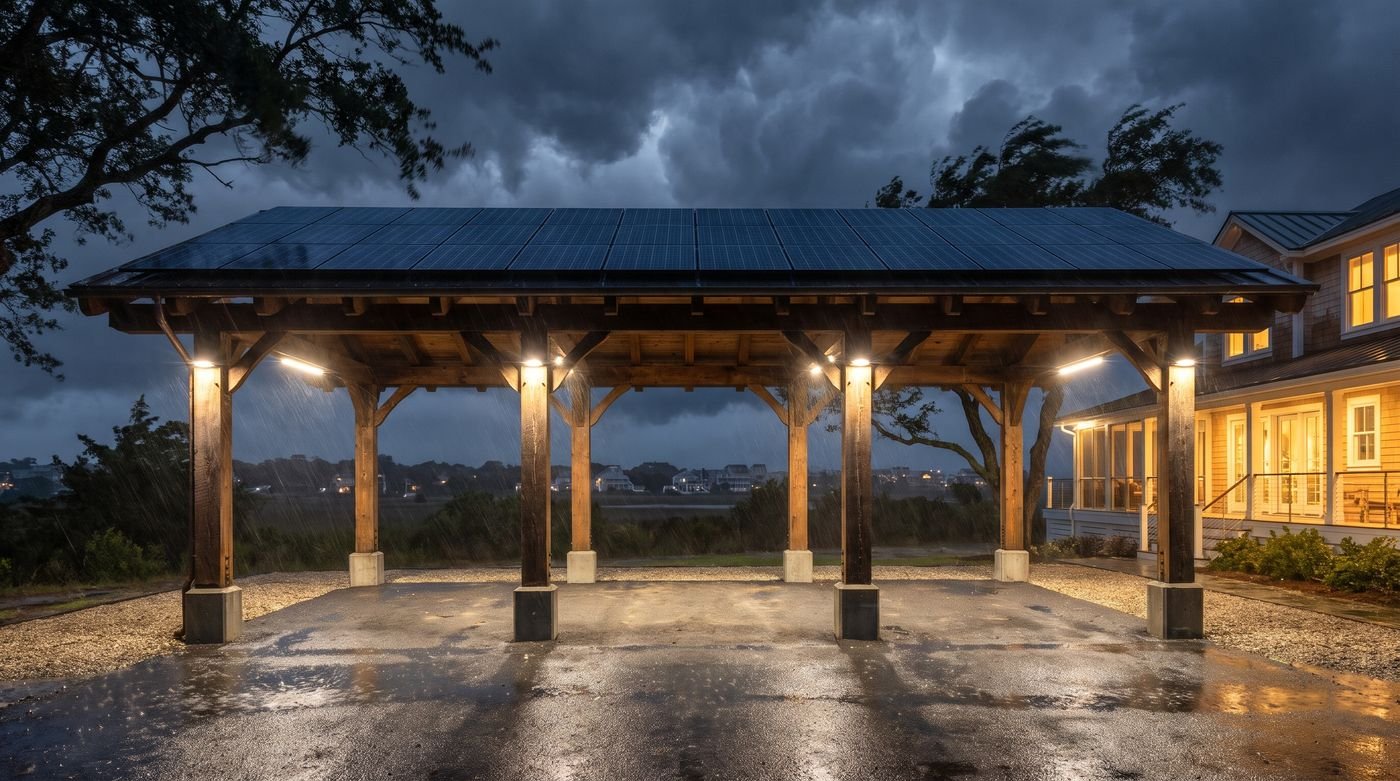
The setup that fixes the cycling for a Tacoma you already own is a battery under a solar carport. The battery runs the bedroom quietly through the night, the panels refill it on every clear day, and the Tacoma only runs to top it up on cloudy ones. Try your own loads in the backup power calculator, or see home backup options compared.
Every truck and SUV that can power a house →
Questions
Can a Toyota Tacoma Hybrid power a house?
Not the whole house. The i-FORCE MAX hybrid has a 2,400-watt, 120-volt AC power supply with outlets in the cabin and the bed. That keeps one bedroom cool with an inverter window air conditioner, plus the fridge, lights and phones, run by extension cord. It has no 240-volt outlet and can't feed the house panel.
Does the Tacoma's engine run the whole time?
No. With the truck on and in park, the hybrid battery carries the load and the engine starts on its own to recharge it. The battery is small, so the engine shuts off for minutes, not hours: in one owner's test, about 10 to 17 minutes off at 360 watts and about 5 minutes off with both outlets near 2,400 watts.
How long does a tank of gas last?
Toyota doesn't publish a figure. The i-FORCE MAX tank holds 18.2 gallons. XOverland relayed a Toyota engineer's figure of about 3/4 gallon an hour with the engine running nonstop, which works out to about 24 hours as a worst case. Because the engine cycles off at lighter loads, real runtime is longer.
Can a Tacoma Hybrid run a well pump?
Some. A 120-volt pump of 1/2 horsepower or less is the realistic limit, run by itself. A Grundfos SQE pump in a 115-volt version has a built-in soft start and plugs in without a transformer. A standard 240-volt 1/2 hp pump needs a step-up transformer plus a soft starter and may still not start. A 1 hp pump is out of reach.
Can a Tacoma Hybrid run an air conditioner?
One room, yes. An 8,000 BTU inverter window unit draws roughly 450 to 550 watts by our math from its Energy Guide label, and it ramps up slowly instead of slamming on. Central air is out of reach.
Can a Tacoma Hybrid heat a house?
With a gas or propane furnace, often yes: the gas makes the heat, and the truck only runs the blower and controls, about 700 watts on a utility's sizing chart. An electrician has to give the furnace a plug-in connection or a small transfer switch. Electric heat pumps and baseboard heat are out of reach.
Sources
- Toyota: 2026 Tacoma press release (2,400W AC power supply, trims)
- Toyota: 2026 Tacoma specifications (18.2-gallon i-FORCE MAX tank)
- Tacoma4G: owner’s inverter and generator-mode test, 2024 Trailhunter
- Tacoma4G: generator mode thread (XOverland’s Toyota fuel figure)
- Portal Hunter: an owner’s deep dive on the 2,400W inverter (battery, off mode)
- Energy Guide label: Midea 8,000 BTU U-shaped window air conditioner
- TechGearLab: Midea U-shaped review (inverter compressor)
- EWEB: generator sizing considerations (appliance watts)
- SoftStartUSA: SoftStart Well Pump generator capabilities
- Signature Solar: SoftStart Well Pump listing
- Grundfos: SQ/SQE technical data (soft start, generator sizing)
- Ferguson: Grundfos 1/2 hp SQE, 115-volt
- Franklin Electric: SubDrive Utility generator sizing
- Vetco: 3,000-watt step-up/step-down transformer
- CDC: use a generator safely