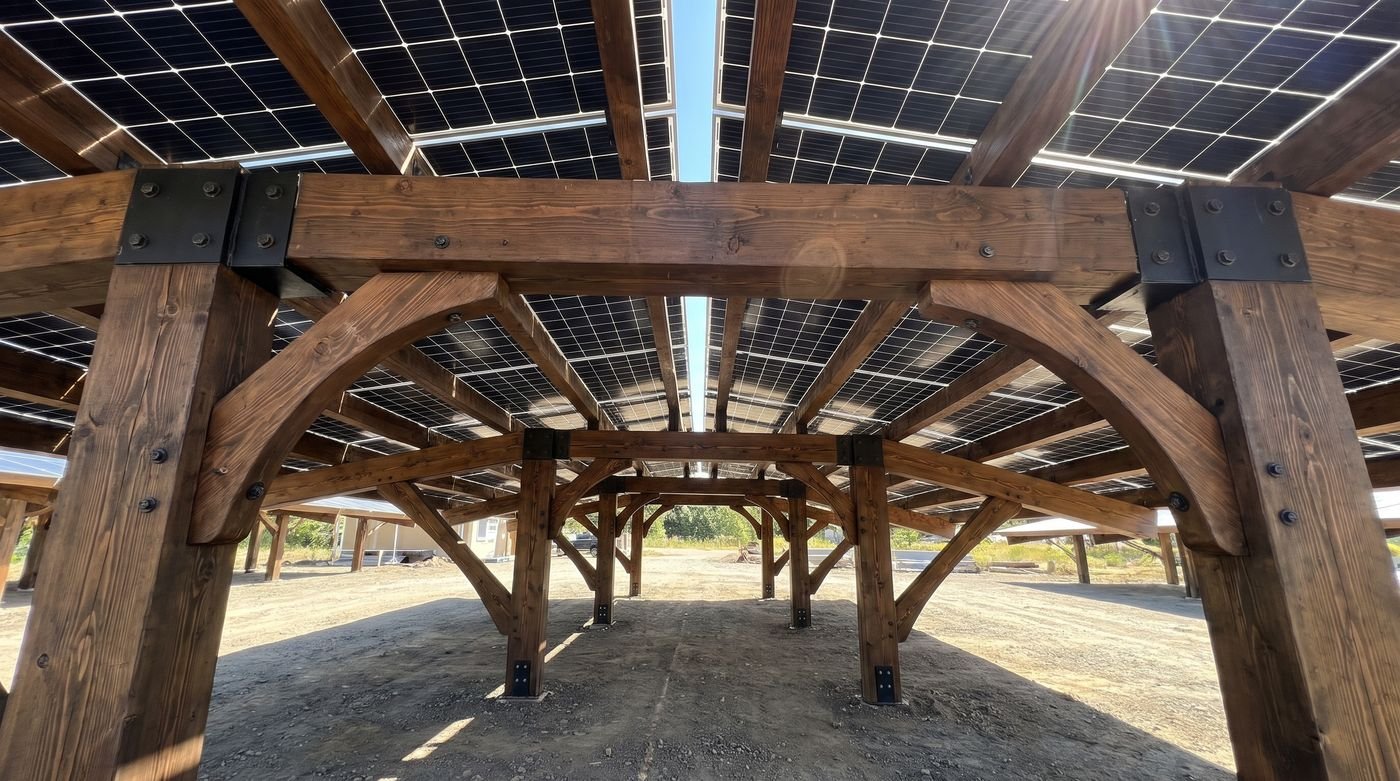
Hurricane-rated
carports
What a solar carport or pergola needs to stand on the coast: the wind, the salt, the water and the paperwork.
Most carport and pergola kits are built for the backyard. On the coast, the same structure has to survive three things the backyard never sees: hurricane wind, salt air and flood water. Each one changes how it has to be built.
1. Wind
A solar roof is a wing. In a hurricane the wind doesn't just push it sideways, it tries to lift it straight off the posts. Every joint, bolt and footing has to hold that pull.
- North Carolina requires a structural analysis where the design wind speed is 130 mph or more. The Outer Banks is in that zone.
- Most backyard kits are rated around 100 mph. Backyard Discovery and Yardistry list 100 mph. That's not a coastal structure.
- Kits built for the coast say so. Pergola Depot rates its solar kit to 165 mph; Chiko rates its steel carport to 150 mph.
- Find your number by address. Your county building office or the free ATC Hazards by Location tool gives the design wind speed for your lot.
2. Salt air
FEMA's coastal building guidance says metal corrosion is worst within about 3,000 feet of the ocean. That decides the hardware.
| Part | Backyard spec | Coastal spec |
|---|---|---|
| Brackets and plates | Powder coat over thin zinc | Hot-dip galvanized (heavier than G185) under powder coat, or 316 stainless |
| Bolts and screws | Zinc-plated | 316 stainless |
| Next to treated lumber | Standard galvanized | Stainless; the copper in treated wood speeds corrosion of galvanized steel |
3. The wood
- Posts in the ground need pressure treatment rated for ground contact (AWPA Use Category 4A or higher).
- Beams overhead can use the lower above-ground rating, unless they'd be hard to replace.
- Treated glulam (layered, glued beams) comes in southern yellow pine rated for ground-contact columns. It's strong, straight and doesn't twist.
- Cedar looks great and resists rot on its own, but it isn't rated for ground contact. Stand cedar posts on steel bases above the ground.
4. Water
An open carport sits at ground level, and on much of the coast that's inside a flood zone. The structure can be built for it; the electrical gear can't sit in the water. Mount the inverter and battery up on the posts, above your lot's flood elevation. Mounted that high, the battery also clears the bumpers. Battery in the carport →
5. The paperwork
A solar carport needs a building permit and an electrical permit, plus HOA approval where there is one. On the coast, the building permit means engineering. A kit that ships with drawings stamped for your site skips the one-off engineering job most buyers pay for separately; one kit seller charges $1,200 just for sealed drawings.
Tell us your size and your site
Which kit, where it's going, and what you'll park or put under it. We're putting the first kits together now.
We answer every message ourselves.
Straight answers
What wind speed should a solar carport be rated for?
The design wind speed for your address, which your county building office or the ATC Hazards by Location tool can give you. North Carolina requires a structural analysis at 130 mph and above, which covers the Outer Banks.
Will a 100 mph carport kit survive a hurricane?
It isn't built for one. Several popular cedar carport kits are rated around 100 mph. Coastal design wind speeds are well above that, and a solar roof adds uplift.
What hardware should I use near the ocean?
Hot-dip galvanized steel under a powder coat, or 316 stainless, with 316 stainless fasteners. Corrosion is worst within about 3,000 feet of the ocean.
Can I use cedar for a coastal carport?
Yes, above the ground. Cedar isn't rated for ground contact, so set cedar posts on steel bases. Posts in the ground need pressure treatment rated for ground contact.
Where does the battery go in a flood zone?
Up on the posts, above your lot's flood elevation, in an outdoor-rated enclosure. That height also keeps it clear of car bumpers.