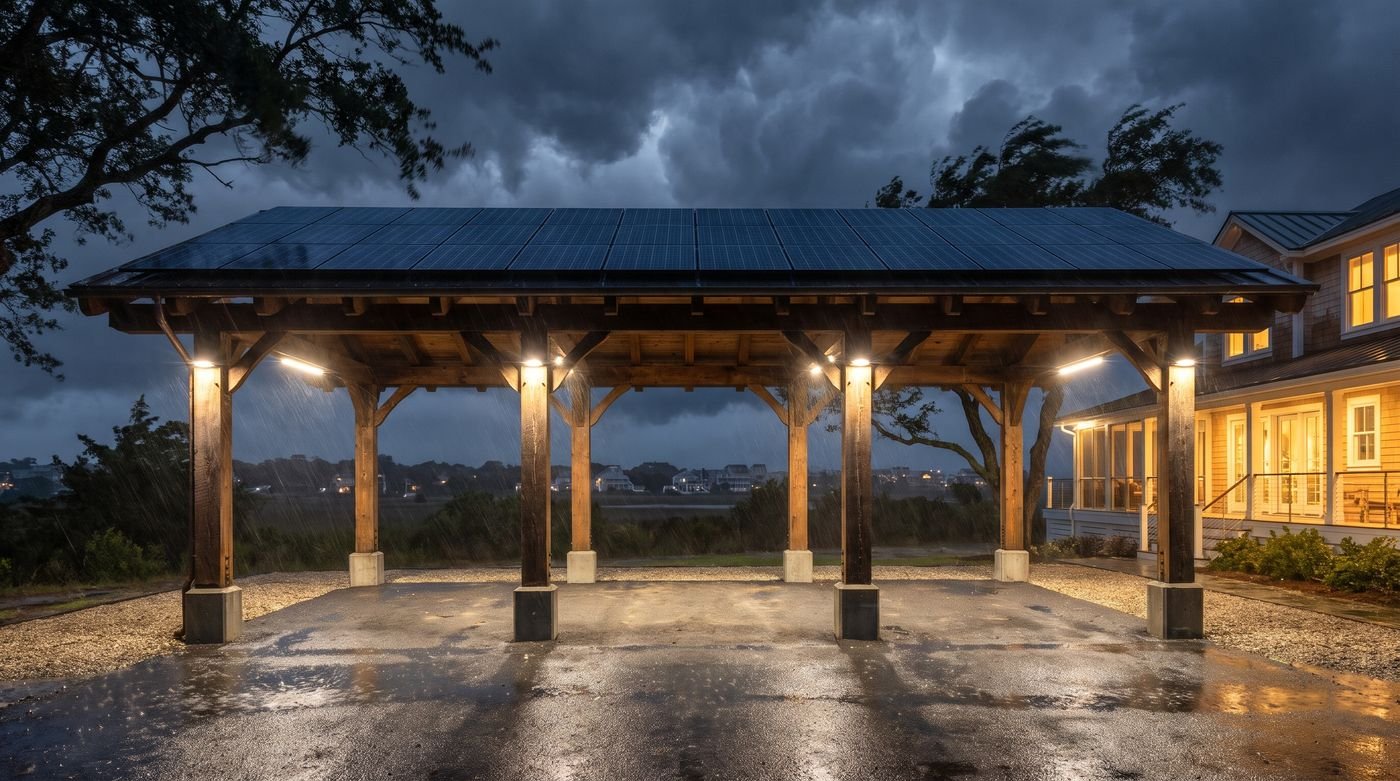
Lower your bill.
Keep the lights on.
One battery, two jobs. Every day it cuts your power bill. When a storm takes the power out, it runs your house.
How it lowers the bill
Your power company doesn't charge the same price all day. On a time-of-use plan, electricity costs about four times as much on weekday afternoons and evenings as it does overnight and on weekends.
The battery takes advantage of that. It fills up when power is cheap or free, from the solar panels on the carport and from the grid late at night. Then, during the expensive hours, the house runs off the battery instead of buying power at the high price. It all happens on its own. You never touch it.
And when the power goes out, the battery is already full. It switches over and keeps the house running.
The two prices here
We're on the Outer Banks, served by Dominion Energy North Carolina. Its residential time-of-use rate is Schedule 1T: one price on-peak, one price off-peak, no demand charge, no games.
| Season | On-peak hours (weekdays only) | On-peak | Off-peak |
|---|---|---|---|
| June – September | 1 PM to 9 PM | 26.9¢ per kWh | 6.3¢ per kWh |
| October – May | 6:30 AM to noon, and 5 PM to 9 PM | 22.4¢ per kWh | 5.7¢ per kWh |
Every other hour is off-peak. All of Saturday and Sunday is off-peak. Listed holidays are off-peak. Those are the energy charges on the tariff filed with the state in 2025; riders and a $14.40 monthly customer charge come on top of both prices, so the real bill is higher across the board, but the gap between night and evening is the point. Evening power costs about four times what night power costs.
Figures from Dominion Energy North Carolina's Schedule 1T tariff, effective February 2025. Rates change; check the current sheet before you count on a number. Other utilities have similar plans under different names.
What the battery does with that
- Daytime. The carport panels charge the battery (and the truck, if it's home). Much of the day falls in the peak window, so every kWh the panels make is a kWh you didn't buy at 22 cents.
- Evening peak. The house runs off the battery. Lights, cooking, TV, heat pump. The grid meter barely moves.
- After 9 PM. Off-peak starts. The battery refills from the grid at 6 cents, ready for the morning peak.
- Weekends. Everything's cheap. The battery coasts and the sun does the work.
The hybrid inverter runs this schedule from the rate plan you give it. Change plans, change the schedule. Lose the grid, and it drops into backup mode without asking.
What it's worth
Here's the honest version. Each kWh you move out of the peak window saves the difference between the two prices: about 17 cents in winter, about 21 cents in summer, less roughly 10 percent for what the battery loses in the round trip. A house that shifts 10 kWh a day out of the peak saves in the range of $1.50 to $1.90 on each weekday, call it $30 to $40 a month, on top of what the panels save by making power during the peak in the first place. Shift more, save more; a 30 kWh battery can move most of a normal day's use.
Illustration only. Your savings depend on your usage, your rate plan and your battery size. We don't publish a payback number because we don't know your house yet.
Why this changes the pitch
A generator is a bill you pay to sit in the yard. A carport battery pays you back every weekday evening and then, when a storm takes the lines down, it's also the thing keeping the fridge cold. One purchase, two jobs. That's the argument that gets a backup system past the kitchen table.
What's in the battery → Backup power calculator → Carport vs. generator →
Straight answers
Do I have to switch rate plans?
To get the night price, yes. Time-of-use is a choice you make with your utility. If you stay on the flat rate, the battery still backs up the house and still soaks up the solar; it just doesn't buy cheap and sell dear.
Does charging at night wear the battery out faster?
It's a cycle a day, which is exactly what LFP home batteries are rated for: 6,000-plus cycles, 15 years and more of this. Sodium-ion, when it arrives, is rated higher still.
What if I'm not a Dominion customer?
Most utilities have a time-of-use plan. The hours and prices differ; the shape is the same. Tell us who sends your bill and we'll look it up.
Does the solar still matter if the grid is this cheap at night?
Yes, because daytime is the expensive time. The panels replace the 22-cent power; the night rate replaces the rest. Together they leave very little to buy at full price.
Stop paying the evening price
Tell us about your place, your bill and what you drive. We'll tell you straight what a carport battery would do for you.