Ford Fathom vs. Tesla Powerwall: we ran the numbers
A Tesla Powerwall 3 costs about $1,000 per kilowatt-hour of backup, installed. A Ford Fathom with Ford’s home equipment could come in around $130 per kilowatt-hour, if you were buying a truck anyway. Here are the numbers, what we assumed, and where the Powerwall still wins.
Everything on the Ford Fathom, kept current →
The short answer
Per kilowatt-hour of backup, a Ford Fathom with Ford’s home equipment looks several times cheaper than a Tesla Powerwall 3, and it holds roughly four to six times as much energy. The Powerwall’s advantage is that it never leaves the house and switches on by itself. Ford has not published the Fathom’s battery size, so we ran two cases and labeled them.
The numbers
| Tesla Powerwall 3 | Fathom, if 50 kWh | Fathom, if 75 kWh | |
|---|---|---|---|
| Usable battery | 13.5 kWh | 50 kWh (assumed) | 75 kWh (assumed) |
| Power to the house | 11.5 kW | A projected 10 kW (Ford) | |
| Home side, installed | About $13,500 | About $6,400–$6,900 (our estimate, below) | |
| Home side per kWh | About $1,000 | About $130–$140 | About $85–$95 |
| Hours of an average home’s use (29 kWh a day) | About 11 | About 41 | About 62 |
| Powerwalls needed to match it | 1 | About 3.7 (about $50,000) | About 5.6 (about $75,000) |
Hours assume a full battery and all of it usable; real systems keep a reserve, so plan on somewhat less. An average U.S. home uses about 29 kWh a day (U.S. Energy Information Administration). Prices are before any incentives.
Where our numbers come from
Powerwall 3. 13.5 kWh usable and 11.5 kW continuous, with the solar inverter built in. EnergySage puts the typical all-in installed cost at $13,473, about $998 per kWh, from real quotes as of May 2026.
Fathom home equipment. Ford has not priced it. Ford says the everyday Home Power Station will cost about half as much as its first two-way charger, and the Home Backup Power Panel at least 60% less than its first backup hardware. Fortune applied those percentages to the F-150 Lightning’s $1,310 charger and $5,205 total and got about $655 and $2,080. For labor, installers quoted Lightning owners $8,900–$9,400 all in, of which $5,205 was equipment, leaving about $3,700–$4,200. Add it up and the Fathom’s home side lands around $6,400–$6,900. Older houses that need a panel upgrade will pay more.
Fathom battery. Not published. A 51 kWh figure going around comes from reader and analyst guesses, not Ford, so we used round 50 and 75 kWh cases. Ford says the truck starts at $28,350 and runs to the high $30,000s, so the bigger battery likely costs more.
Counting the truck
If you were going to buy a pickup anyway, only the home side counts, and the Fathom stores energy for a fraction of a Powerwall’s cost. Count the whole truck and it still comes out ahead: about $35,000 for 50 kWh is around $700 per kWh, and you get a truck with it.
Where the Powerwall wins
- It stays home. If the Fathom is at the beach when the power goes out, the house has nothing.
- It switches on by itself. The Powerwall takes over the moment the grid drops and ties straight into the solar panels. The truck has to be home and plugged in.
- It is built for daily cycling. Using a truck battery every day to shave the power bill adds wear, and Ford has not said how that affects the truck’s warranty. The Powerwall carries a 10-year warranty with 70% of capacity retained.
Under a solar carport
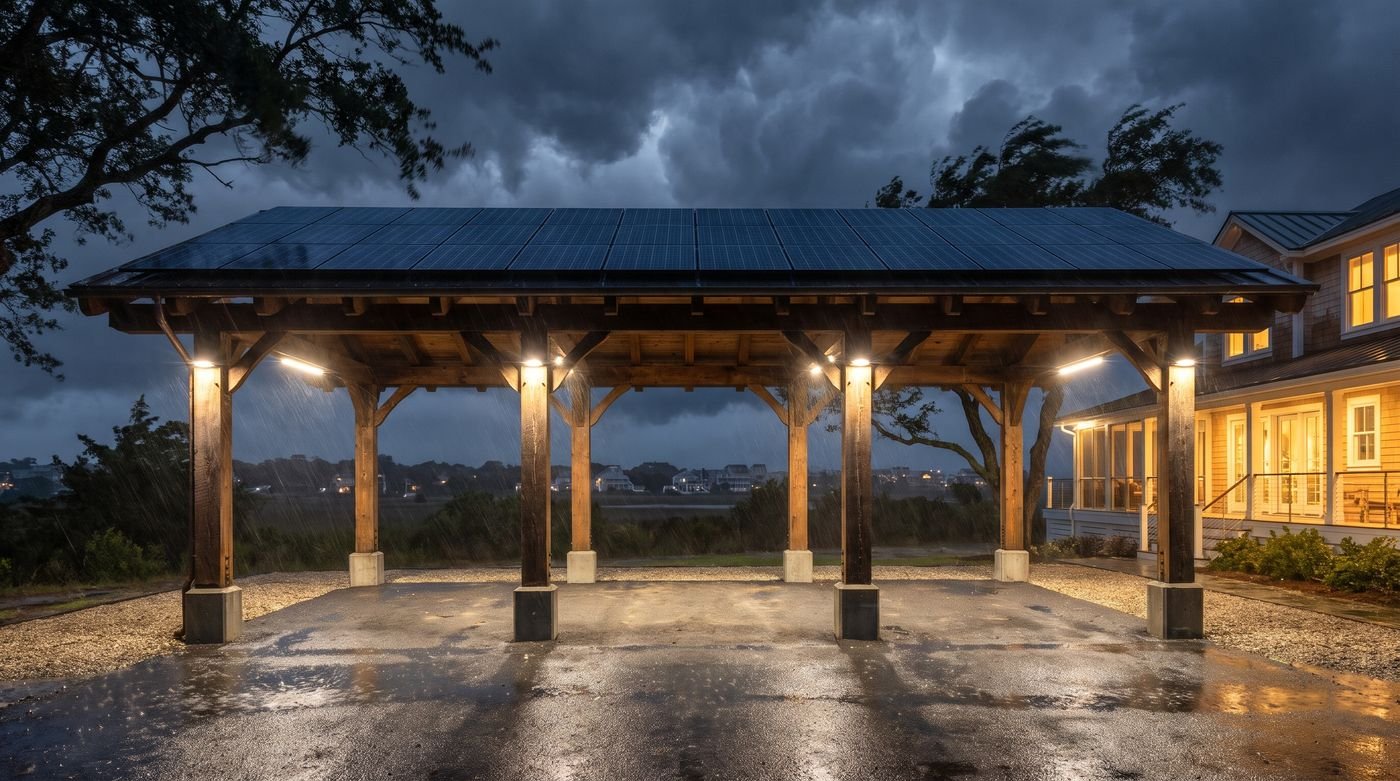
A solar roof sized for two trucks makes around 25 kWh on an average day in coastal North Carolina, most of a day of an average home’s use. That turns a big truck battery from a countdown into something the sun refills. The strongest setup may be both: a small home battery for the always-on basics, and the truck for the long outages.
Ford Fathom price and home power →
Home batteries under the carport →
Why home backup equipment is still brand-specific →
Sources
Questions
Is a Ford Fathom cheaper than a Tesla Powerwall for home backup?
Per kilowatt-hour, it looks that way. A Powerwall 3 costs about $13,500 installed for 13.5 kWh, about $1,000 per kWh. Ford’s home equipment for the Fathom is estimated at $6,400 to $6,900 installed; with a 50 kWh battery that is about $130 to $140 per kWh of backup. Ford has not published the battery size or equipment prices yet.
How long could a Ford Fathom power a house?
Ford has not said. If the battery is 50 kWh, a full charge holds about 41 hours of an average home’s use (29 kWh a day); at 75 kWh, about 62 hours. Real systems keep a reserve, so expect somewhat less, and more if you run only essentials.
Why would anyone still buy a Powerwall?
It stays at the house, takes over the instant the grid drops, connects directly to solar panels and is built to cycle every day under a 10-year warranty. A truck only backs up the house when it is home and plugged in.
Ready when the lights go out
Tell us about your place and what you drive, or plan to. We'll tell you straight what a Bugging Out carport would do for you.