What you only find out the first night
Eleven small surprises that are not in the brochure, and what each one really is.
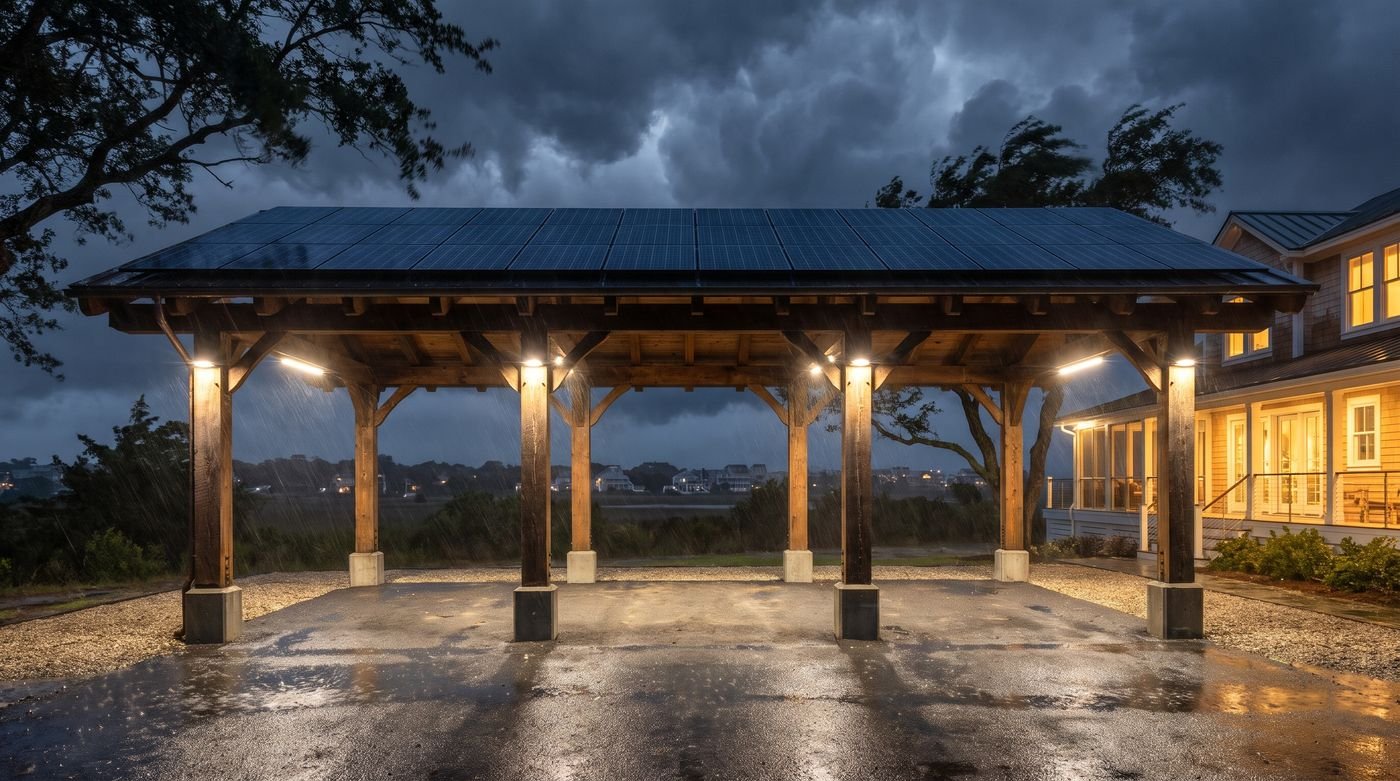
Bugging Out carport, illustrationIn short: Most of what goes wrong on the first night of an outage is small: a blank thermostat, a little drain pump nobody plugged in, an oven that needs power even though it burns gas. Each one takes five minutes to sort out on a calm day and an hour by flashlight.
By Bret, founder of Bugging Out Solar, on the Outer Banks of North Carolina
None of this is in the brochure for the generator or the battery. These are the surprises people report after their first real outage, with what each one really is. Nearly all of them are a thing that quietly needed electricity and nobody knew it.
The thermostat is blank
It is probably not broken. Thermostats come two ways. Some run on their own batteries. Others take their power from the furnace through the thermostat wire, and Honeywell Home's support pages describe both kinds. If yours is the second kind, a dead furnace means a dead thermostat, and it comes back when the furnace has power again. If yours takes batteries, change them before storm season.
The furnace has power and still shuts off
A high-efficiency gas furnace makes water as it runs. In many houses a small pump, about the size of a shoebox, carries that water to a drain. The pump has its own plug, and it is often on a different circuit than the furnace. If the pump has no power, its little tank fills, a safety switch trips, and the furnace shuts down. Carrier's furnace manual says so in plain words: a failed drain pump can shut the furnace off. So the pump goes on backup power along with the furnace. It draws very little.
The furnace lights, then quits a few seconds later
That one has its own explanation and its own fix. On some generators and batteries the furnace cannot confirm its flame is lit, so it shuts the gas off. Why it happens and how to test for it →
The gas stove will not light, and the oven is dead
The burners on top of many gas ranges can be lit with a match while the power is out. The oven is a different story. GE Appliances says the oven cannot be lit by hand, because its igniter and gas valve need electricity. So plan on stovetop cooking, and keep a box of matches or a lighter in the kitchen drawer.
There is hot water, or there isn't
It depends on which gas water heater you have. An older tank type with a pilot light generally keeps heating with no power at all. A tankless gas water heater does not: A. O. Smith and Noritz both say theirs stop working in an outage, because electricity runs the ignition, the controls and the fan. The quick test is in your basement or utility closet right now. If the water heater has a power cord, it needs power.
The refrigerator hums, clicks and goes quiet
It is trying to start and not getting the kick it needs. A refrigerator needs several times its running power for the first second. If the generator is already busy, or the battery is too small, the compressor gives up and tries again a few minutes later. Unplug it, take the other loads off, and start it by itself. Start it empty, stop it empty →
The battery charges from the wall but not from the generator
Owners report this most often with big open-frame generators and a portable power station (the box often sold as a “solar generator”). The battery's charger is picky about the power it is fed, and some generators make power too rough for it. It is a mismatch, not a broken battery. Which generators will charge a battery →
The Wi-Fi is on and the internet is not
You put the modem and router on the battery, the lights on them come up, and nothing loads. Your internet company's equipment down the street needs power too, and whatever backup it has may not outlast a long outage. Nothing in your house fixes that. A phone used as a hotspot is the usual fallback, for as long as the cell towers hold.
Water: none coming in, or too much
If your house is on a well, no power means no water. Many well pumps run on 240 volts, which a small 120-volt generator cannot supply, so check the label on yours. Before a storm, fill jugs for drinking and a bathtub for flushing.
The opposite problem is the sump pump, the pump in the basement floor that keeps groundwater out. It only runs when the power is on, and the storm that takes out the power is often the one that brings the water. If you have one, it goes at the top of the list of things to run on backup, and it is worth one test on a calm day.
The garage door will not open
The opener is dead, and the car is inside. Every opener has a release, usually a red cord hanging from the track, that disconnects the door so you can lift it by hand. Chamberlain's instructions say to pull it with the door fully closed. Pull it on an open door and the door can come down hard. Find the cord now and try it once.
The generator starts, runs a minute and quits
Three usual suspects. A fuel valve was left closed. The vent on the gas cap was left closed. Or the oil is low: Honda's manuals describe a sensor that stops the engine before the oil gets too low, and the switch stays in the ON position, so it looks like the generator simply died. Check the oil first. It also explains why a generator that ran fine last year will not stay running this year.
Why this list exists
Every item here is easy when the lights are on, the stores are open and nobody is cold. That is the whole case for a dress rehearsal: one calm afternoon running the house on backup power, so the first night of the real thing has no surprises left in it.
One thing to do today
Walk to your furnace and your water heater and count the power cords. Furnace, drain pump, water heater: every cord you find is something that needs backup power, and now you know it before the storm does the telling.
For reporters
Use the numbers and quote this piece freely. All we ask is a link back to this page. A line you can use as written:
“A gas furnace can have power and still quit, because the little drain pump beside it does not. Most first-night surprises are like that: something small that quietly needed electricity.”
To reach us, use the form at Talk to Us.
Sources
- GE Appliances: using a gas range during a power outage
- Carrier furnace owner's manual: condensate drain and pump
- Pentair Flotec condensate pump manual: safety switch
- A. O. Smith: does a gas tankless water heater need electricity?
- Noritz: will I get hot water if there is a power outage?
- Chamberlain: how to manually open or close a garage door
- Honda generator owner's manual: Oil Alert system
Ready when the lights go out
Tell us about your place and what you drive, or plan to. We'll tell you straight what a Bugging Out pool house or carport would do for you.