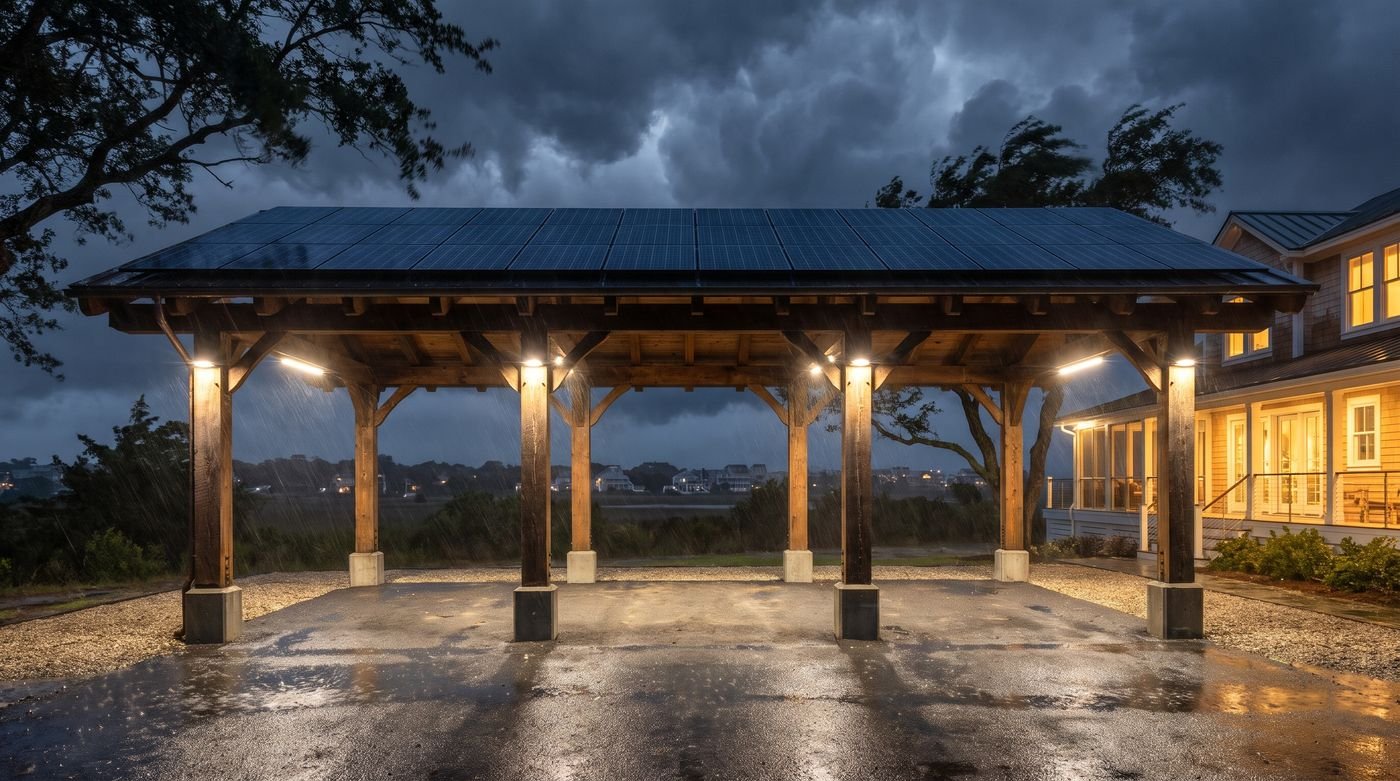
After a summer storm: one cool room
Central air is out of reach for a small generator. One window unit and a few fans are not.
Bugging Out carport, illustrationIn short: Central air pulls 2,500 to 3,000 watts and more than that to start, which is why a small generator won’t run it. A window air conditioner pulls about 1,500. A portable fan pulls about 40. So cool one room with the generator, and sleep under a fan on the battery.
By Bret, founder of Bugging Out Solar, on the Outer Banks of North Carolina
On the Outer Banks the power goes out in the hot months. A hurricane leaves the air thick and still, and the first night without air conditioning is the one people remember. This is the summer version of one warm room.
The numbers
| What | Running watts | Source |
|---|---|---|
| Central air conditioning | 2,500 to 3,000 | National Bureau of Standards, 1981 |
| Window air conditioner, 10,000 BTU | 1,500 (2,200 to start) | Honda wattage guide |
| Whole-house fan (the big one in the hallway ceiling) | 400 to 500 | National Bureau of Standards, 1981 |
| Portable fan | 40 (120 to start) | Honda wattage guide |
Starting power is the catch with anything that has a compressor. Honda lists 2,200 watts to start a 10,000 BTU window unit, and some units pull more, so read the label on yours and try it on your generator before you count on it.
One cool room
Pick a bedroom with a door. Put the window unit there. Run it on the generator in the afternoon and evening, with the door shut and the curtains closed, and let it pull the heat and the damp out of that one room. A closed room that has been cooled and dried stays comfortable for a while after the unit goes off.
Then shut the generator down for the night and sleep under a fan on the battery. A 40-watt fan runs about 50 hours on a 2,048 watt-hour power station (the box often sold as a “solar generator”). That is several nights from one charge, in silence.
What a fan does and does not do
A fan does not cool the air. It cools you, by moving air across your skin. That is why a fan in an empty room is wasted power, and why a fan pointed at the bed is worth more than a bigger fan pointed at the room.
Moving outside air through the house only helps when the outside air is cooler than the inside air. The Department of Energy says the same of whole-house fans. So open the house at night and in the early morning, and close the windows and curtains by mid-morning to keep the cool in.
A fan also does not take the damp out of the air. The air conditioner does, which is the reason to run the window unit for a few hours even if you plan to sleep under a fan.
If you have a whole-house fan
At 400 to 500 watts it is well within reach of a small generator, where central air is not. Run it at night with the windows open. The Department of Energy notes two drawbacks: it can be loud, and it does not filter the air it brings in.
Where it stops
Heat is harder on older people than on anyone else, and they are the last to complain. If someone in the house, or the neighbor who lives alone, is not coping, the cool room is theirs, or it is time to drive them somewhere with power.
One thing to do today
Read the label on your window air conditioner for its watts or amps, and try it on your generator on a hot afternoon. If you don’t own a window unit, that is the piece of summer backup to think about before a storm is on the map.
For reporters
Use the numbers and quote this piece freely. All we ask is a link back to this page. A line you can use as written:
“Central air needs 2,500 to 3,000 watts, and a small generator cannot run it. A window unit in one bedroom needs about 1,500, and a fan needs about 40. After a summer storm the plan is one cool room.”
To reach us, use the form at Talk to Us.
Sources
Ready when the lights go out
Tell us about your place and what you drive, or plan to. We'll tell you straight what a Bugging Out pool house or carport would do for you.