Use less, and the battery you have gets bigger
Every watt you don’t use is one you don’t have to make, carry gas for, or listen to.
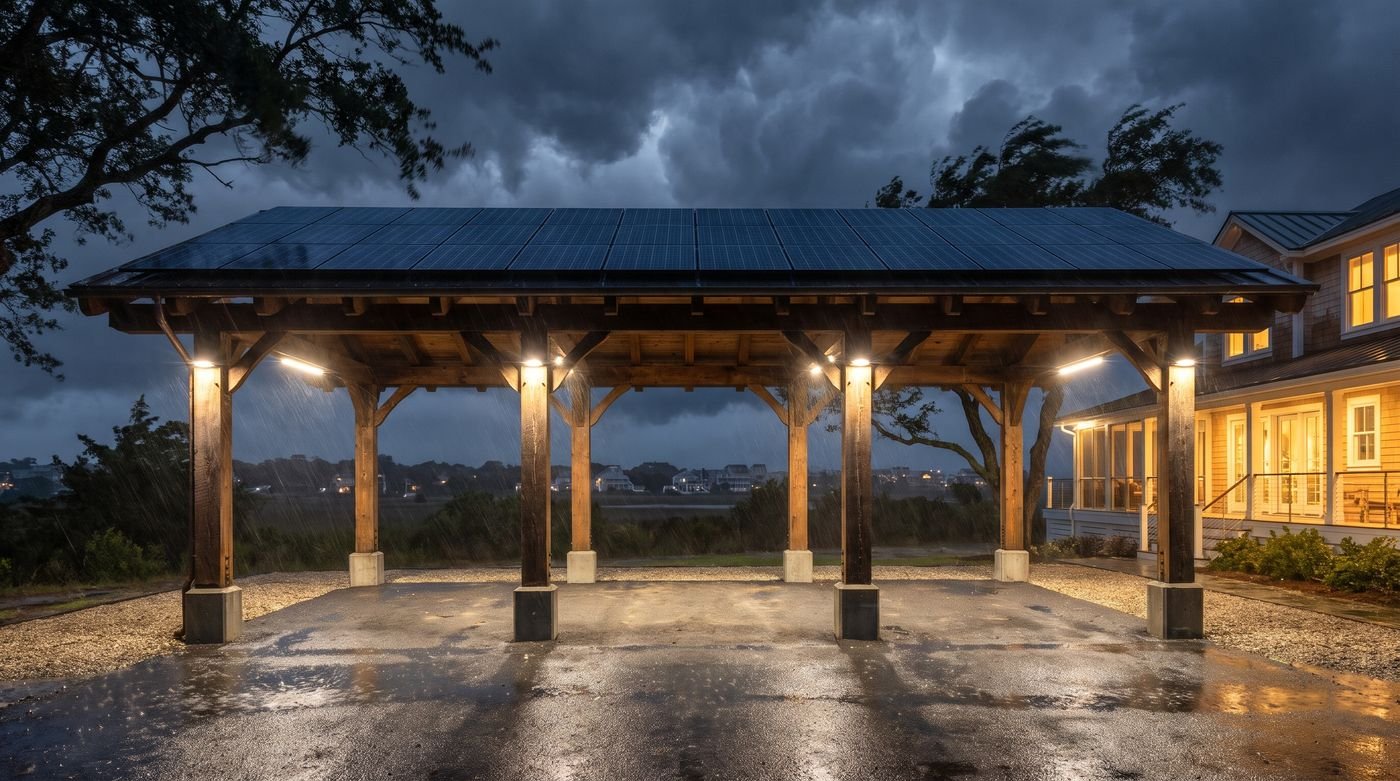
Bugging Out carport, illustrationIn short: Switch off the things that draw power around the clock for nobody. Make heat once, while the generator is running anyway, and store it in a thermos, a wrapped pot or a cold room. Then a small battery does the work of a big one.
By Bret, founder of Bugging Out Solar, on the Outer Banks of North Carolina
People size backup power for the way they live on a normal Tuesday. That is why the systems get so big. For a few days without the grid, the cheaper move is the other one: use less, and what you already own goes further. None of this is hardship. Most of it you won’t notice.
The quiet drains
The loads that empty a battery are often not the big ones. They are the small ones that never stop.
| Left on around the clock | Watts | Share of a 2,048 watt-hour battery per day |
|---|---|---|
| Modem and Wi-Fi router together | 12.7 | About 15 percent |
| An old cable box, switched “off” (the worst one in a 2001 Berkeley study) | 23 | About 27 percent |
| One portable fan | 40 | About 47 percent |
The modem and router. Ericsson measured one household’s pair at a steady 12.7 watts, and found the draw hardly moves whether anyone is online or not. That is small, but over a day it is a real slice of a battery, spent while everyone is asleep. Switch them off overnight. And if the internet company’s equipment up the street is down, switch them off altogether, because they are connecting to nothing.
The battery’s own outlets. The part of a power station that makes household power uses power just by being on, with nothing plugged in. EcoFlow’s manual says to turn the AC button off when it is not in use. Charge phones from the USB ports, which don’t need it.
Anything that glows while it is off. Cable boxes, game consoles, printers, anything with a clock or a little light is drawing power. Newer equipment is far better than that 2001 cable box, but in an outage there is no reason to feed any of it. Pull the plugs for the duration.
Find your own. You don’t have to guess. Plug things into the battery one at a time and read the watts on its screen. Most houses turn up one surprise.
Make heat once, and store it
Anything that makes heat is expensive: a coffee maker pulls about 600 watts and a microwave about 1,500. So make the heat once, in the hours the generator is running anyway or on a gas burner, and keep it.
Fill every thermos in the house. One pot of boiling water in the morning is hot coffee, tea and soup all day, with nothing switched on.
Breakfast in a thermos. Oatmeal and boiling water, closed up at night, is ready in the morning.
The fireless cooker. Your great-grandmother knew this one, and the USDA published instructions for it in 1914. Bring a lidded pot of stew, beans or rice to a full boil, then take it off the heat and bury it in blankets or set it in a picnic cooler packed with towels. It keeps cooking on its own heat. One published guide gives about 25 minutes for soft foods and two to three hours for harder ones. Bring it back to a boil before you serve it.
Store cold and cool the same way
The same idea works in the other direction. While the generator is running, let the refrigerator and freezer pull all the way down, freeze water bottles, and in summer cool one closed bedroom with a window unit. Then shut the generator off and coast on what you stored. The refrigerator as an ice chest → One cool room →
People, not air
Warm the bed, then switch off. Run the electric blanket for twenty minutes before you get in, then turn it off. The covers hold it. One warm room →
Point the fan at the bed, not the room. A fan cools skin, not air, so a fan in an empty room is wasted. In dry air a damp towel on your neck in front of a fan does a surprising amount. On a muggy night on the coast, the fan alone is doing the work.
Follow the heat. Warm air rises. Sleep downstairs in summer and upstairs in winter.
Stack the hungry jobs
If you run a generator a few hours a day, put every big job inside those hours: charge the battery, run the refrigerator, make the coffee, heat the water, do a load of laundry, run the well pump and fill the jugs. The generator is burning the gas either way. Outside those hours, the battery carries only the small things. How the generator and the battery share the work →
One thing to do today
Walk through the house tonight with the lights off and count the little lights that are still on. Every one of them is something to unplug when the power goes out.
For reporters
Use the numbers and quote this piece freely. All we ask is a link back to this page. A line you can use as written:
“A modem and router together draw about 13 watts. Left on around the clock, that is roughly 15 percent of a 2,048 watt-hour battery every day, most of it spent while the house is asleep.”
To reach us, use the form at Talk to Us.
Sources
- Ericsson research brief: household measurements of modem and router power
- UC Berkeley and Lawrence Berkeley National Laboratory (2001): standby power in California homes
- Honda: generator wattage estimation guide
- EcoFlow DELTA Max user manual: turn off the AC button when not in use
- Tearfund: cooking without fire (the fireless cooker)
Ready when the lights go out
Tell us about your place and what you drive, or plan to. We'll tell you straight what a Bugging Out pool house or carport would do for you.