Backup power, one step at a time: from free to a solar carport
You don’t have to buy the big system to be ready. Each step below stands on its own, and each one makes the next one smaller.
In short: Start with what costs nothing. Every step that cuts what the house needs makes whatever you buy later smaller and cheaper.
By Bret, founder of Bugging Out Solar, on the Outer Banks of North Carolina
Step 1: What costs nothing
Fill the empty space in the freezer with water bottles before a storm. A full freezer holds its cold about 48 hours with the door shut, against about 24 for a half-full one. Here is how.
Then decide now what you would keep running: the refrigerator, the heat or one cool room, the phones and a few lights. Everything else gets switched off on the first night.
Step 2: Small things that cut what you need
An electric blanket uses about 50 to 200 watts where a space heater uses up to 1,500. Warm the person, not the room.
Step 3: A battery you can carry
A portable power station (often sold as a “solar generator”) runs the small things in silence: phones, lights, Wi-Fi, a blanket, a gas furnace fan for a few hours. A 2,000 watt-hour unit runs a 500-watt furnace fan for about 4 hours of fan time. More on the furnace.
Step 4: A small generator to refill it
A small generator makes far more electricity per gallon running hard into a battery than idling along all day. Honda’s figures for its EU2200i work out to about 58% more per gallon at full load. Why gallons matter more than watts. And how to pair the two. Not sure what size? See the generator comparison guide.
Step 5: The truck you may already own
Some hybrid and electric pickups can run a house. Ford says an F-150 PowerBoost with the 7.2 kW option can carry a home using about 30 kilowatt-hours a day for up to five days, through a switch at the meter that costs about $1,100 plus installation. What your truck can do.
Step 6: Power that refills itself
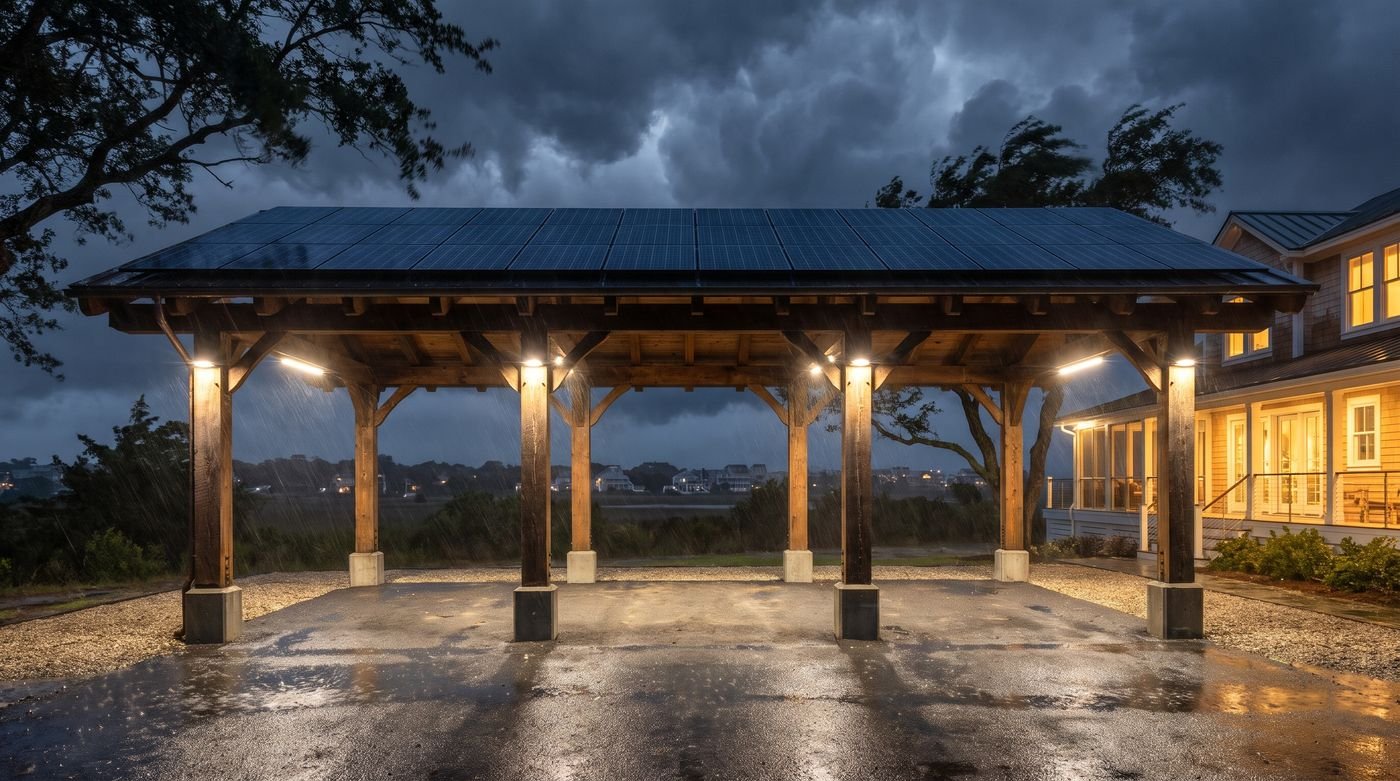
A generator needs fuel deliveries. Solar with a battery refills every clear day for as long as the outage lasts, and it lowers the power bill the rest of the year. That is what a solar carport or pool house is for, and it works alongside everything above.
How the pieces fit together
None of this is one big purchase. It is a few simple things that each make the next one easier.
Before the storm, fill the empty space in the freezer with water bottles and let them freeze solid. A full freezer holds its cold about 48 hours with the door shut, against about 24 for a half-full one. Here is how.
When the power goes out, that ice is doing work. The freezer coasts for hours with no power at all, so the generator does not have to run around the clock to save the food. A run in the morning and a run in the evening may be all it needs.
While the generator runs, it cools the refrigerator back down, charges the phones and fills the battery with what is left over.
When the generator is off, the battery runs the furnace fan, a few lights and the Wi-Fi in silence, and the frozen bottles hold the freezer.
Every outage and every house is different, and nobody can tell you how long yours will last. Once you know how these pieces work, you can stretch your fuel and your battery to fit whatever comes.
See your own numbers
The backup power calculator lets you pick what you want to keep running and shows how long a battery lasts and how many hours a generator has to run.
For reporters
Use the numbers and quote this piece freely. All we ask is a link back to this page. To reach us, use the form at Talk to Us.
Ready when the lights go out
Tell us about your place and what you drive, or plan to. We'll tell you straight what a Bugging Out pool house or carport would do for you.