Storm week fact sheet: the numbers, with sources
One page for a reporter on deadline. Every number links to where it came from.
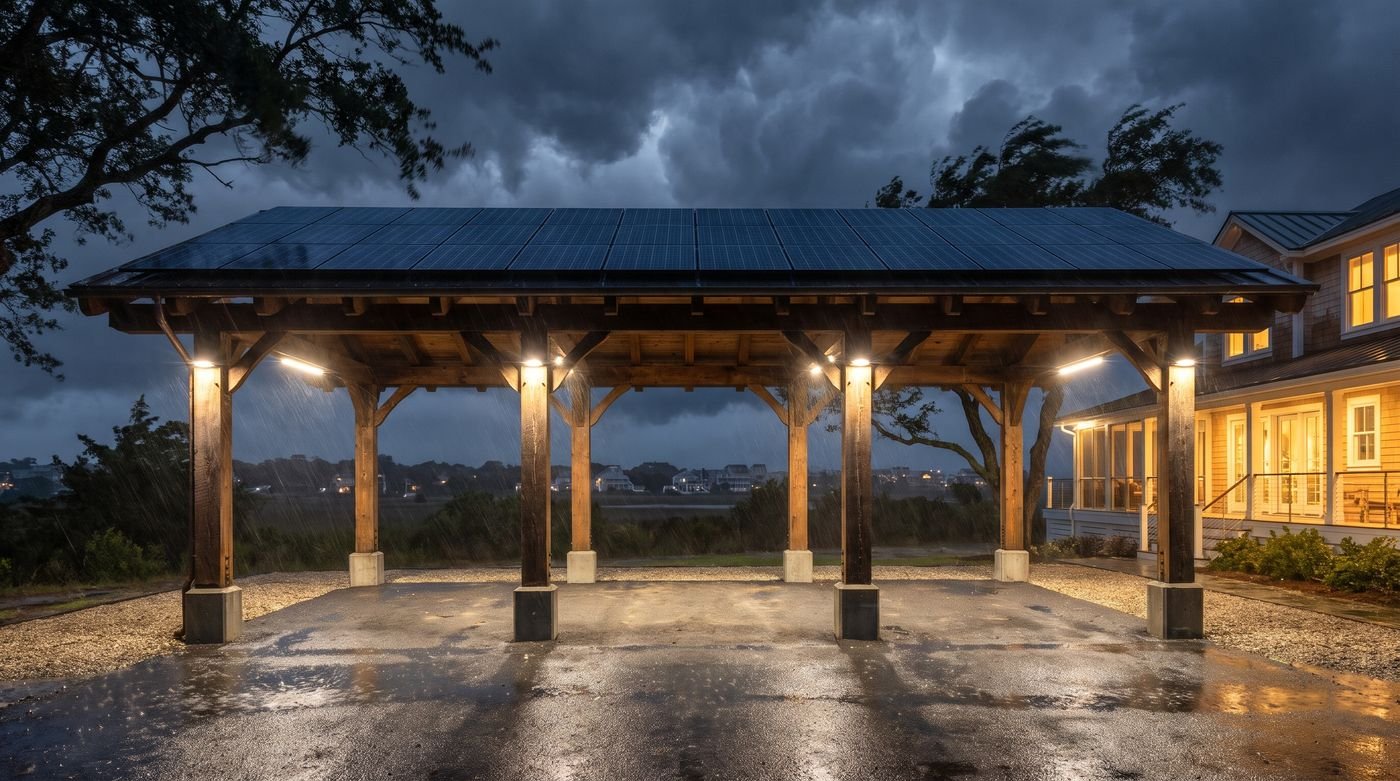
Bugging Out carport, illustrationIn short: Every number in the tables on this page comes from a government agency or a manufacturer’s own document, and the link is in the same row. Use any of it. All we ask is a link back.
By Bret, founder of Bugging Out Solar, on the Outer Banks of North Carolina
How long the power stays out
| Fact | Number | Source | More |
|---|---|---|---|
| Average time without power per U.S. customer, 2024 | About 11 hours, the most in 10 years | EIA, December 2025 | Our page |
| Share of those hours caused by major events such as hurricanes | 80 percent | EIA, December 2025 | Our page |
| A normal year, major events left out | About 2 hours | EIA, December 2025 | |
| North Carolina, 2024 (the Helene year) | 1,518 minutes, about 25 hours; 144 minutes with major event days left out | EIA Table 11.2 | |
| North Carolina, 2025 | 192 minutes, about 3 hours | EIA Table 11.2 | |
| Virginia, 2025 | 763 minutes, about 13 hours (from utilities serving about 31 percent of customers) | EIA Table 11.2 | |
| United States, 2025 | 269 minutes, about 4.5 hours | EIA Table 11.2 |
The state and 2025 figures are from EIA’s table of utilities that report by the industry-standard (IEEE) method. In North Carolina those utilities serve about 90 percent of customers.
Generators and fuel
| Fact | Number | Source | More |
|---|---|---|---|
| Deaths from portable generator carbon monoxide | Nearly 100 a year | CPSC, January 2024 | Our page |
| Small inverter generator (Honda EU2200i), run time on its 0.95 gallon tank | 8.1 hours at quarter load, 3.2 hours at full rated load | Honda | Our page |
| 22 kW whole-house standby generator, propane use | 2.53 gallons an hour at half load, 3.90 at full load | Generac | Our page |
| Passenger car at idle | 0.2 to 0.5 gallons an hour | Argonne National Laboratory | Our page |
| Ford F-150 PowerBoost hybrid, built-in generator | 7.2 kilowatts | Ford | Our page |
What things draw
| Fact | Number | Source | More |
|---|---|---|---|
| Gas furnace fan | 300 to 875 watts running | Honda wattage guide | Our page |
| Window air conditioner, 10,000 BTU | 1,500 watts running, 2,200 to start | Honda wattage guide | Our page |
| Central air conditioning | 2,500 to 3,000 watts | National Bureau of Standards, 1981 | Our page |
| Portable fan | 40 watts running | Honda wattage guide | Our page |
| Electric blanket against a space heater | About 100 watts against 1,500 | Anker (a battery maker’s article) | Our page |
Food and water
| Fact | Number | Source | More |
|---|---|---|---|
| Refrigerator with the door kept shut | Food stays cold about 4 hours | FDA | Our page |
| Freezer with the door kept shut | About 48 hours full, 24 hours half full | FDA | Our page |
| The line for refrigerated food | 40 degrees; meat, milk, eggs and leftovers go after 4 hours above it | FDA | Our page |
| Water to store | 1 gallon per person per day | Ready.gov | Our page |
| Boil-water notice | Rolling boil for 1 minute | CDC | Our page |
Things people don’t know until the first night
- A gas oven will not light without electricity, though many stovetop burners will light with a match (GE Appliances).
- A tankless gas water heater stops in an outage (A. O. Smith, Noritz).
- A high-efficiency gas furnace can shut down because its small drain pump has no power (Carrier).
- A garage door opener’s release cord is meant to be pulled with the door closed (Chamberlain).
Sources for each are on What you only find out the first night.
Three things a household can do today
- Freeze water bottles to fill the empty space in the freezer. Why →
- Run the house on backup power for one calm afternoon. The checklist →
- Count the power cords at the furnace and the water heater. What they mean →
Who we are and how to reach us
Bugging Out Solar is on the Outer Banks of North Carolina. Bret, the founder, runs a generator most days at a lot with no utility power. Use the form at Talk to Us.
Ready when the lights go out
Tell us about your place and what you drive, or plan to. We'll tell you straight what a Bugging Out pool house or carport would do for you.